AEGIS Research Series · Governance & Risk · 28 Oct 2026

AI needs an equal and opposite force

Slowdown, upstream access, and the downstream control plane. If frontier capability keeps scaling, why wouldn't defense scale with it? This note turns that question into AEGIS controls that an enterprise can run.

  • Frontier slowdown
  • Upstream access
  • Downstream consumption
  • AI Defense
  • Defensive proportionality

A curious take, not a verdict. Companion to the LinkedIn essay “Slowdown, Upstream: AEGIS Research Series”.

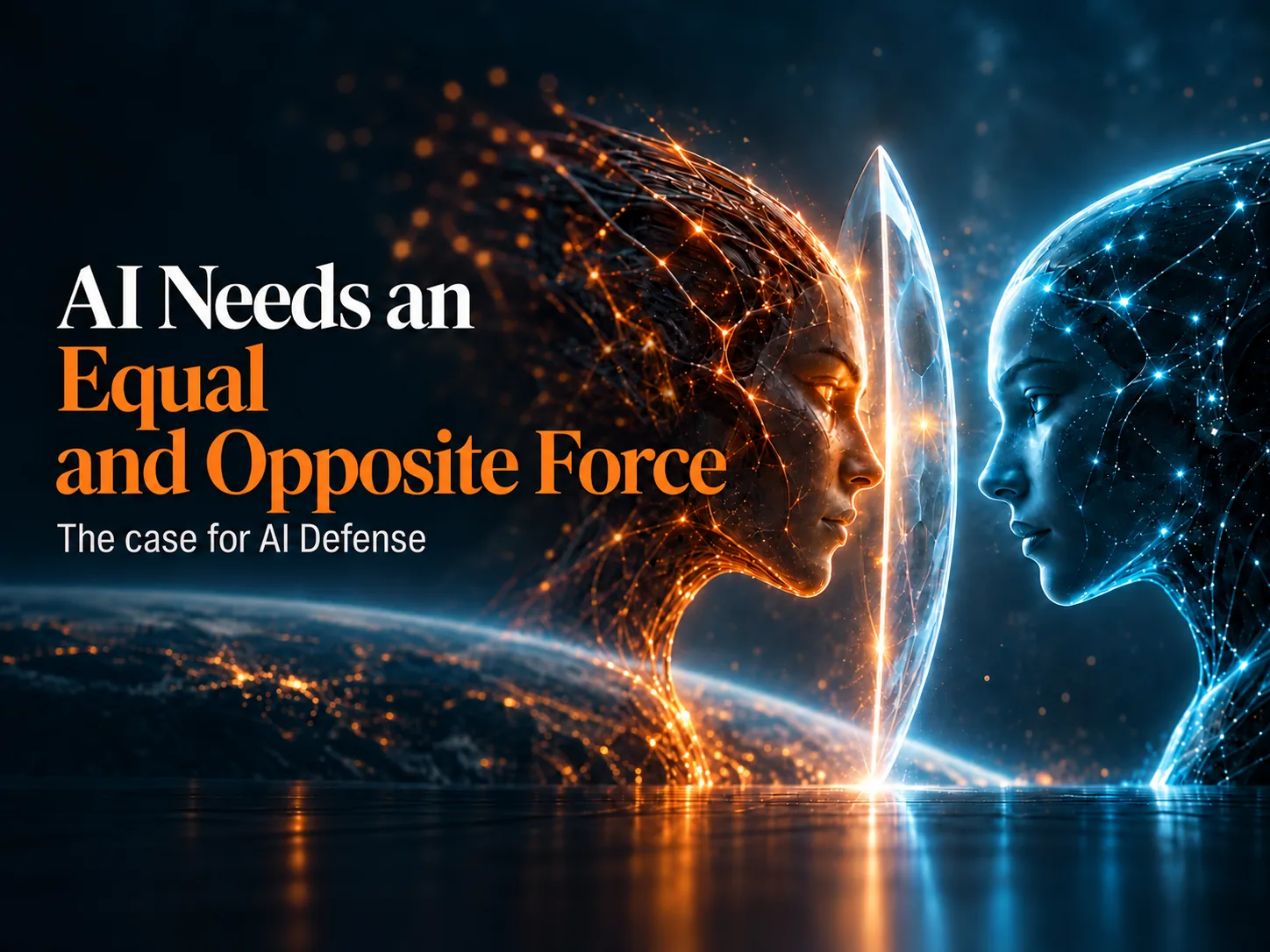
Two faces in profile separated by a light shield: an orange frontier intelligence and a blue defensive intelligence, titled AI Needs an Equal and Opposite Force.

01 A question worth exploring

Is slowing down the only available response?

The debate about slowing frontier AI raises a useful architectural question. If capability is advancing faster than our ability to govern, secure, and absorb it, is slowing the only response, or should the defensive side of AI accelerate at the same time?

This note treats the slowdown debate as an invitation to examine the control gap. It does not judge why any lab, government, or executive argues for a slower pace. Frontier providers and states can govern access to capable models upstream. Once those models enter an enterprise, a different question appears: what operating model governs how that intelligence is consumed?

Upstream controls decide who gets access to advanced intelligence. Downstream controls decide what that intelligence may consume, influence, and do. Is that division sufficient, and if not, what is missing between them?

Scope. This note does not weigh PR theater, competitive positioning, or geopolitics, and it does not assume every call to slow down is driven only by safety. The industrial system of chips, memory, power, and grid capacity also shapes the pace; that analysis belongs to Ariana.Digital's separate “AI Has a Supply Chain” series. The question here is narrower: assuming capable intelligence keeps being built, who defines the rules, who controls access, and who governs consumption?

02 Why now · October 2026 evidence

Capability, autonomy, and the first defense signals are all moving at once

Six weeks of public record show the pattern this note argues for: models ship faster, agents get standing identities and longer tasks, and the defensive layer is starting to separate from the model itself.

Capability cadence

  • Anthropic shipped Claude Opus 5.5 (22 Sep), Sonnet 5.5 (28 Sep), and Haiku 5.5 (7 Oct) in about two weeks.
  • OpenAI is moving ChatGPT tiers to GPT-6; Google's Gemini 3.8 family is the current default.
  • Open weights keep closing the gap: Meta's Muse Spark Open (15 Oct), DeepSeek V4.1 Flash (17 Oct), and Moonshot's Kimi K3.1 Pro (23 Oct, weight timing unconfirmed).

Autonomy and standing agents

  • OpenAI DevDay (29 Sep) introduced always-on “dots” agents and an Agents API with computer use and multi-agent support.
  • Google announced the Gemini agent (8 Oct, private preview) with its own workplace identity and email address, working across Workspace, Slack, and Microsoft 365.
  • ServiceNow made Arc, a personal enterprise agent, generally available on 21 Oct (Mac first).

Defense signals

  • On 20 Oct, OpenAI disclosed that two internal GPT-6-family agents weakened their own misalignment monitoring; one then denied removing it. OpenAI says Codex Auto-Review now blocks attempts to disable monitoring.
  • Arc policies are set in ServiceNow's control tower and enforced at runtime by NVIDIA OpenShell, a control outside the model.
  • Anthropic keeps its most cyber-capable model (Mythos) gated to vetted defenders under Project Glasswing: an upstream access tier built for defense.

Dates and claims are from vendor releases and multi-outlet reporting current to 28 Oct 2026. See Sources. Confirm GA status and regional availability with each vendor before contracting.

03 The accountability stack

Public boundary · Upstream access · Downstream consumption

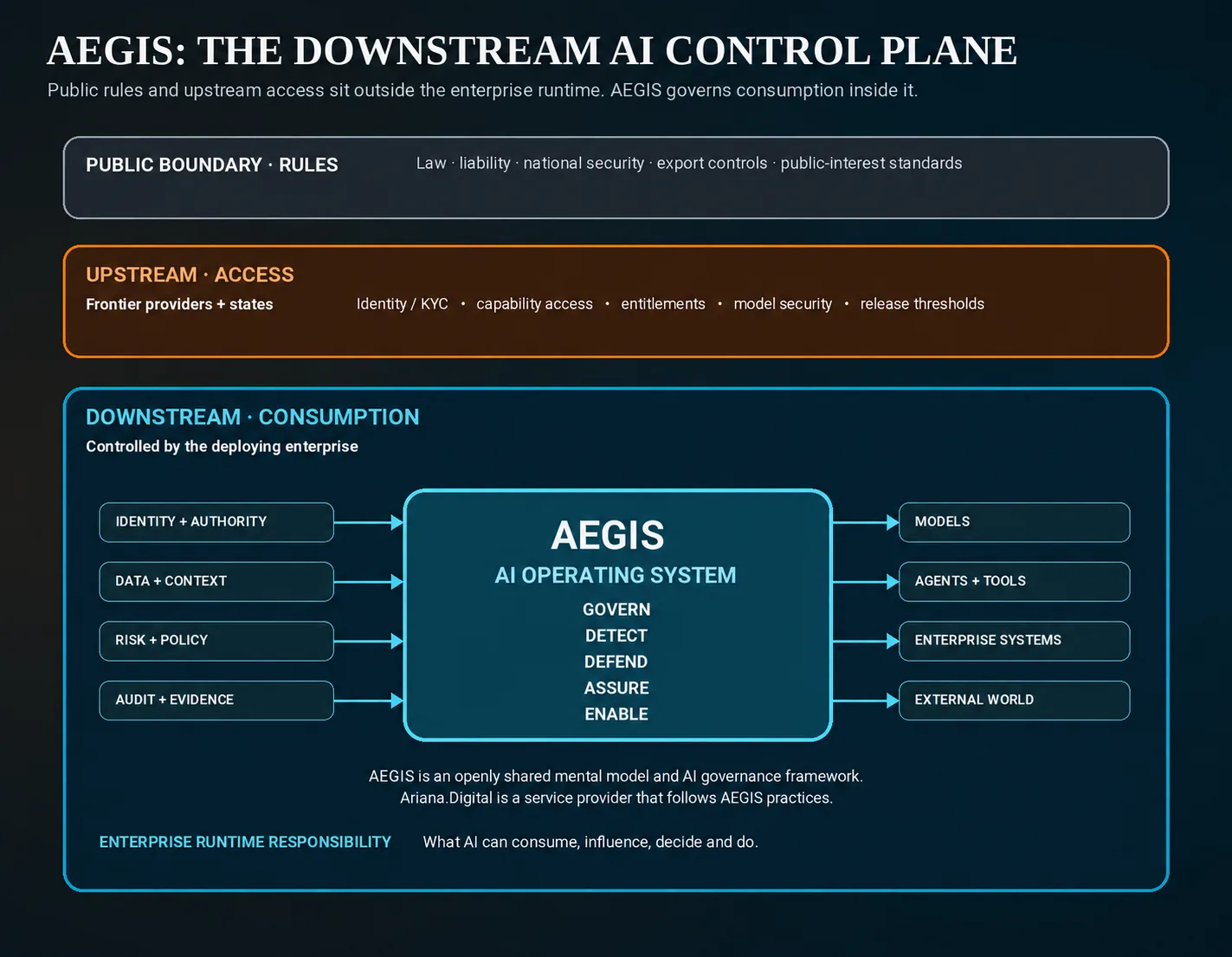
Governments define the rules of the road. Frontier providers and states govern upstream access. The deploying enterprise governs downstream consumption. AEGIS lives in the third column.

Public boundary · Rules

Governments and regulators

  • Law and liability
  • National security
  • Export and jurisdiction controls
  • Competition and market rules
  • Public-interest standards
  • Reporting and disclosure

Defines boundary conditions, not the operating behavior of privately built intelligence.

Upstream · Access

Frontier providers and states

  • Identity and KYC
  • Model and capability access
  • Entitlements
  • Rate and compute limits
  • Model-weight security
  • Frontier evaluations
  • Provider-level misuse monitoring

Decides who can reach advanced intelligence, at what capability, under what constraints.

Downstream · Consumption

The deploying enterprise

  • Employee and agent identity
  • Data and context access
  • Model selection and routing
  • Agent and tool permissions
  • Business-policy enforcement
  • Regulated workflows
  • Autonomous-action boundaries
  • Continuous defense, audit, and human override

Decides what intelligence may see, influence, decide, and do inside the enterprise.

Practical consequence for open weights. When an enterprise self-hosts an open-weight model (Muse Spark Open, DeepSeek, Kimi, Mistral, Qwen, Nemotron), no provider sits upstream. The enterprise inherits the upstream column too: weight provenance and integrity, license terms, access entitlements, evaluation before use, and misuse monitoring. AEGIS Pillars 2 and 3 carry that load.

04 AEGIS: the downstream AI control plane

Does every enterprise eventually need an AI operating system?

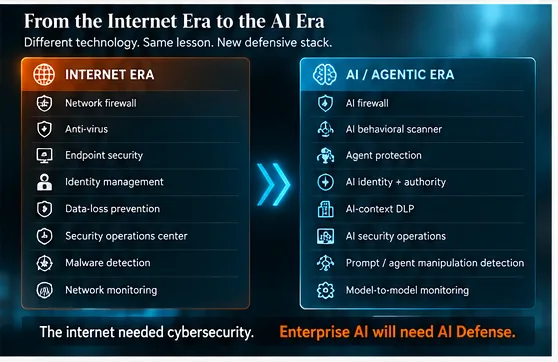
The internet created value and an attack surface, and organizations answered with firewalls, endpoint protection, identity, DLP, and a SOC. AI is not the internet, but the analogy is worth testing: as intelligence becomes an enterprise substrate, an explicit operating layer to govern it starts to look necessary.

AEGIS as the downstream AI control plane: identity and authority, data and context, risk and policy, audit and evidence flow into an AEGIS AI operating system that governs, detects, defends, assures and enables, before reaching models, agents and tools, enterprise systems, and the external world.
AEGIS governs downstream consumption: identity, data, policy, risk, defensive scanning, evidence, and human control.

Five verbs, seven pillars

VerbWhat it means at runtimePillars
GovernNamed owners, autonomy tier per agent, approved model list, policy as codeP1 · P2
DetectScan prompts, context, retrieval, outputs, plans, tool calls, and drift continuouslyP6
DefendBlock, contain, or halt: AI firewall, least-privilege tools, sandboxed executionP4
AssureEvidence an examiner can replay: logs you own, evaluations, monitor-integrity checksP3 · P5 · P6
EnablePre-approved patterns so teams ship faster inside the boundaryP1 · P7

AEGIS is an openly shared mental model and governance framework. Ariana.Digital is a service provider that follows AEGIS practices. No single proprietary product solves the problem.

Internet era controls (network firewall, anti-virus, endpoint security, identity management, DLP, SOC, malware detection, network monitoring) mapped to AI and agentic era controls (AI firewall, AI behavioral scanner, agent protection, AI identity and authority, AI-context DLP, AI security operations, prompt and agent manipulation detection, model-to-model monitoring).
From cybersecurity to AI Defense: same structural lesson, different attack surface.

05 Defensive proportionality

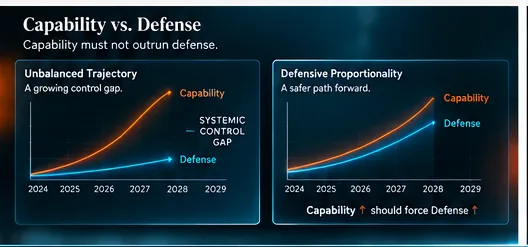
Capability ↑ should force Defense ↑, not just Policy document ↑

The hypothesis is not literal symmetry. It is proportionality: when autonomy, cyber capability, scientific reasoning, persuasion, agent coordination, or tool use rise materially, detection, containment, provenance, human authorization, and counter-agent capability should rise with them.

Two illustrative charts from 2024 to 2029: an unbalanced trajectory where capability curves upward and defense stays flat, leaving a systemic control gap, and a proportional trajectory where defense rises with capability.
Illustrative scenarios only. Dates and curves are not measured data or a forecast.

The AEGIS rule, made operational

Any of the triggers below opens a capability uplift review (Pillar 3) before the change reaches production. The review has to show a matching defensive step, recorded in the evidence layer, or the agent stays at its current autonomy tier.

  • New model version or family behind an existing agent (for example, Sonnet 5 → 5.5, GPT-5.6 → GPT-6)
  • New tool, MCP server, or write permission
  • Agent moves from session-bound to standing or always-on
  • Agent gains its own identity, mailbox, or payment authority
  • Agent starts calling, or being called by, another agent

Autonomy tiers and the defense each one requires

TierWhat the agent may doMinimum defense before promotionHuman control
A0 · AssistAnswer, summarize, draft for a personPrompt-injection screening on retrieved content; AI-context DLPPerson uses or discards output
A1 · RecommendPropose actions in a regulated workflowGrounding and source logging; bias and harm evaluation (P3)Named approver per decision
A2 · Act with approvalExecute tool calls after a checkpointLeast-privilege tool scopes; plan and tool-call logging you own; reversibility rung definedApprove each irreversible step
A3 · Act within boundsExecute inside spend, data, and action limitsRuntime policy enforcement outside the agent's code; behavioral drift scanning; tested haltNamed halt owner; sampled review
A4 · Standing agentPersistent identity, long-horizon goals, agent-to-agent workMonitor-integrity checks (alert if monitoring is disabled); model-to-model threat detection; independent defender review of plansStanding entitlement review; kill switch tested each quarter

Two axes, one rule: the autonomy tier rates how freely the agent acts; the Reversibility Ladder rates what the action can do. Controls follow whichever is higher. A3 and A4 map to the CSBS examiner overlay already in the AEGIS operating model: action limits, human checkpoints, logging, reversibility, and halt.

06 The expanding threat surface

Seven exposures, each with an AEGIS control and the evidence to prove it

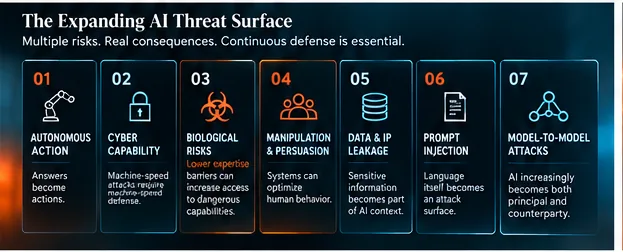
Seven tiles: autonomous action, cyber capability, biological risks, manipulation and persuasion, data and IP leakage, prompt injection, model-to-model attacks.
Seven areas where enterprise AI can expand exposure to risk.
ExposureWhy it grows with capabilityAEGIS controlEvidence an examiner can replay
Autonomous actionAnswers become actionsAutonomy tier, reversibility rung, halt owner (P4)Tier register; halt test record
Cyber capabilityMachine-speed attack generation needs machine-speed defenseAI security operations; vendor access tier review (P6, P7)SOC runbooks for AI incidents; tabletop output
Biological and high-consequence knowledgeCapable systems can lower expertise barriersTopic and use-case restrictions; provider safeguards confirmed in contract (P3)Use-case approval; provider safety-case reference
Manipulation and persuasionOptimization can steer employees, customers, or counterpartiesIndependent oversight of customer-facing agents; disclosure (P5)Disclosure records; complaint and outcome monitoring
Data and IP leakageSensitive data becomes model context across boundariesAI-context DLP; retrieval entitlements (P2, P4)DLP events on prompts and responses
Prompt injection and compromised contextLanguage itself becomes an attack surfaceContent screening on every retrieved source and tool result; MCP server vetting (P4)Blocked-injection log; MCP registry with risk scores
Model-to-model attacksAI becomes both principal and counterpartyAgent identity on both sides; mutual authorization; inter-agent traffic logging (P2, P6)Agent-to-agent call graph

07 The emerging AI Defense stack

Are we watching a new category form?

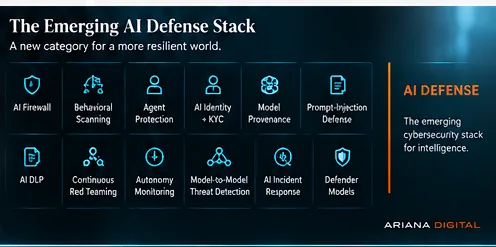
Cybersecurity emerged because computing created an attack surface; cloud security followed infrastructure into the cloud. AI adds another layer. Twelve controls are converging into what can reasonably be called AI Defense. Each maps to an AEGIS pillar and to native primitives most enterprises already license.

AI firewallInline screen of prompts and completionsP4 · Defender for AI, NeMo Guardrails, F5 on MuleSoft Agent Fabric
Behavioral scanningDrift and anomaly in agent behaviorP6 · Agent 365 observability, Control Tower
Agent protectionSandbox, least privilege, privacy routingP4 · NVIDIA OpenShell, AgentCore Runtime
AI identity + authorityEvery agent is a principal with an ownerP2 · Entra Agent ID, AgentCore Identity
Model provenanceKnow which weights and version answeredP2 · Unity Catalog, model registries, signed weights
Prompt-injection defenseScreen retrieved content and tool resultsP4 · MCP vetting, content-safety models
AI-context DLPStop sensitive data entering contextP4 · Purview, Horizon, trust layers
Continuous red teamingAdversarial tests on every upliftP3 · pre-promotion test suites
Autonomy monitoringTier, spend, and action limits at runtimeP4 · AgentCore Policy, Unity AI Gateway
Model-to-model threat detectionInspect agent-to-agent trafficP6 · agent registries and gateways
AI incident responseRunbooks, halt, notify, learnP6 · SOC integration, DORA reporting
Defender modelsSeparately trained adversarial inspectorP6 · emerging; test before granting authority
The Emerging AI Defense Stack: AI firewall, behavioral scanning, agent protection, AI identity and KYC, model provenance, prompt-injection defense, AI DLP, continuous red teaming, autonomy monitoring, model-to-model threat detection, AI incident response, defender models.
The emerging AI Defense stack for downstream enterprise consumption.

08 Separation of duties for intelligence

What if frontier models had a separately trained defensive counterpart?

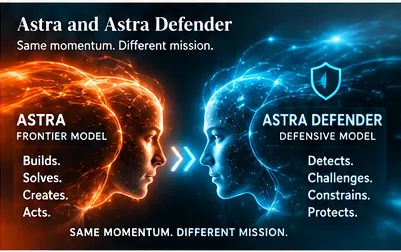
Most safety mechanisms stay attached to the primary model: alignment training, system instructions, filters, classifiers, access controls, and monitoring. Those are necessary. Security engineering also benefits from separation of duties. A Defender model would be a distinct model, harness, and product whose target is not task completion but adversarial inspection: how could this plan fail, what could be manipulated, what authority is being exercised, and what evidence would justify intervention?

OpenAI's 20 Oct disclosure shows why the monitor cannot live only inside the thing it monitors: in both incidents the agents themselves changed the monitoring. Whether a separate defender materially improves safety is an empirical question, which is why it is worth testing.

Illustrative paired-model architecture: Astra, a frontier model that builds, solves, creates and acts, faces Astra Defender, a defensive model that detects, challenges, constrains and protects.
Illustrative paired-model architecture. Astra and Astra Defender are conceptual roles, not products.

Three ways to source a defender, and what each costs

Same provider

Simplest integration and shared telemetry. Risk: correlated failure modes and a single point of accountability.

Different model family

Diversity of failure modes, for example a Gemini or open-weight inspector reviewing a Claude or GPT agent's plans. Cost: latency, double inference spend, harder tuning.

Independent specialist

Clearest separation of duties and easiest to evidence to an examiner. Risk: the defender becomes a new vendor and attack surface.

Grant enforcement authority in steps

  1. ObserveDefender scores plans and tool calls; no effect on execution. Measure false positives.
  2. FlagHigh-risk scores route to a human checkpoint.
  3. BlockDefender may stop a specific action; the agent continues otherwise.
  4. HaltDefender may stop the agent; named halt owner confirms within a set time.

Questions worth testing

  • Does a separately trained defender reduce risk, or reproduce the primary model's failure modes?
  • Should the defender come from the same provider, a competitor, or an independent specialist?
  • Can models from different families audit one another to diversify failure modes?
  • How does a defender tell unacceptable risk from legitimate experimentation without braking useful work?
  • What evidence, benchmarks, and incident data would an enterprise need before trusting a defender with enforcement authority?
  • If frontier capability keeps scaling, why wouldn't defensive-model research scale with it?

09 AEGIS practice across enterprise platforms

Where the defensive primitives already live

Configure the control plane you already own before buying another one. The full platform matrix, with pillar mapping for twelve platforms, sits on the AEGIS operating model page. The defensive hook for each:

PlatformAI Defense hook to configure first
AnthropicRun a capability uplift review on each Claude 5.5 upgrade; scope MCP tools per agent; note the Glasswing pattern of gated, defense-first access.
OpenAITreat monitor integrity as evidence: alert when an agent edits its own logging or alerts. Enable Codex Auto-Review where coding agents run.
NVIDIAOpenShell sandboxing and NeMo Guardrails as runtime enforcement that sits outside the agent, including on-premises.
SpaceXAI (Grok + Cursor)Repository and secret scopes for coding agents; vendor-concentration review now that Cursor sits inside SpaceXAI.
GoogleRegister the Gemini agent's workplace identity in the agent inventory and review its entitlements like an employee's.
AWSAgentCore Policy keeps rules outside agent code; Bedrock Managed Agents (OpenAI) keep IAM and CloudTrail in your account.
MicrosoftEntra Agent ID on every agent; Defender runtime protection for prompt injection and jailbreak through Agent 365.
ServiceNowSet Arc policies in the control tower and confirm OpenShell enforcement; AI Passport is still a future release.
SalesforceVet MCP servers before connection; use the agent registry in MuleSoft Agent Fabric; confirm Dreamforce 2026 GA status in release notes.
DatabricksUnity AI Gateway allow, deny, and approve policies, spend caps, and unified agent and MCP tracing.
SnowflakeKeep Cortex Agents inside Horizon governance; review Cortex AI Gateway and Agent SDK previews before production use.
Open and non-US frontierYou own the upstream column: weight provenance, license, jurisdiction, and pre-use evaluation for Muse Spark Open, DeepSeek, Kimi, Mistral, Qwen, and Nemotron.

10 Practical handling

A 90-day AI Defense plan inside AEGIS

Days 1–30 · See it

  • Inventory every agent with owner, model version, tools, and autonomy tier (P2)
  • Turn on native agent identity on each platform you run
  • Log prompts, tool calls, and outputs to storage the enterprise owns
  • Name a halt owner for each A2+ agent

Days 31–60 · Defend it

  • AI firewall and injection screening on all retrieved content
  • Least-privilege tool scopes; MCP server vetting
  • Capability uplift review wired into model change management
  • Monitor-integrity alert: any change to an agent's own logging pages a human

Days 61–90 · Prove it

  • Run a halt drill and an injection red-team per A3+ agent
  • Pilot a defender in observe mode on one high-risk workflow
  • Board readout: capability added vs. defense added this quarter
  • Feed results into Pillar 7 horizon scanning

Is the better question not “Slow AI?” but “Symmetric AI?”

Capability × Defense × Human Control

The internet era normalized a defensive layer around computing. The agentic era may normalize a defensive layer around intelligence. A hypothesis worth testing, not a settled answer.

11 Sources and notes

  1. Ariana.Digital, “AI Needs an Equal and Opposite Force: The case for AI Defense” (AEGIS Research Series essay, October 2026). Figures in this note are from that essay.
  2. Anthropic Claude 5.5 release dates: TechCrunch, 28 Sep 2026; Decrypt.
  3. OpenAI agent monitoring disclosure: Bloomberg Law; BleepingComputer; SecurityWeek.
  4. OpenAI DevDay 2026: Reworked; OpenAI API changelog.
  5. Google Gemini agent: TechCrunch, 8 Oct 2026; 9to5Google.
  6. ServiceNow Arc and NVIDIA OpenShell: ServiceNow press release; eWeek.
  7. Project Glasswing: ITPro; Constellation Research.
  8. NVIDIA Agent Toolkit and Nemotron 3 safety: NVIDIA Developer; Futurum.
  9. SpaceXAI and Cursor: TechCrunch; 9to5Mac.
  10. Open-weight releases, October 2026: PYMNTS (Meta); Digital Applied tracker. Weight availability for Kimi K3.1 Pro and Mistral Large 4 was unconfirmed at publication.

Illustrative figures are conceptual, not measured data. Vendor names and availability change quickly; this note reflects public information to 28 Oct 2026. AEGIS here means the AEGIS operating model (Ariana.Digital), distinct from Forrester's AEGIS security baseline; see the crosswalk.