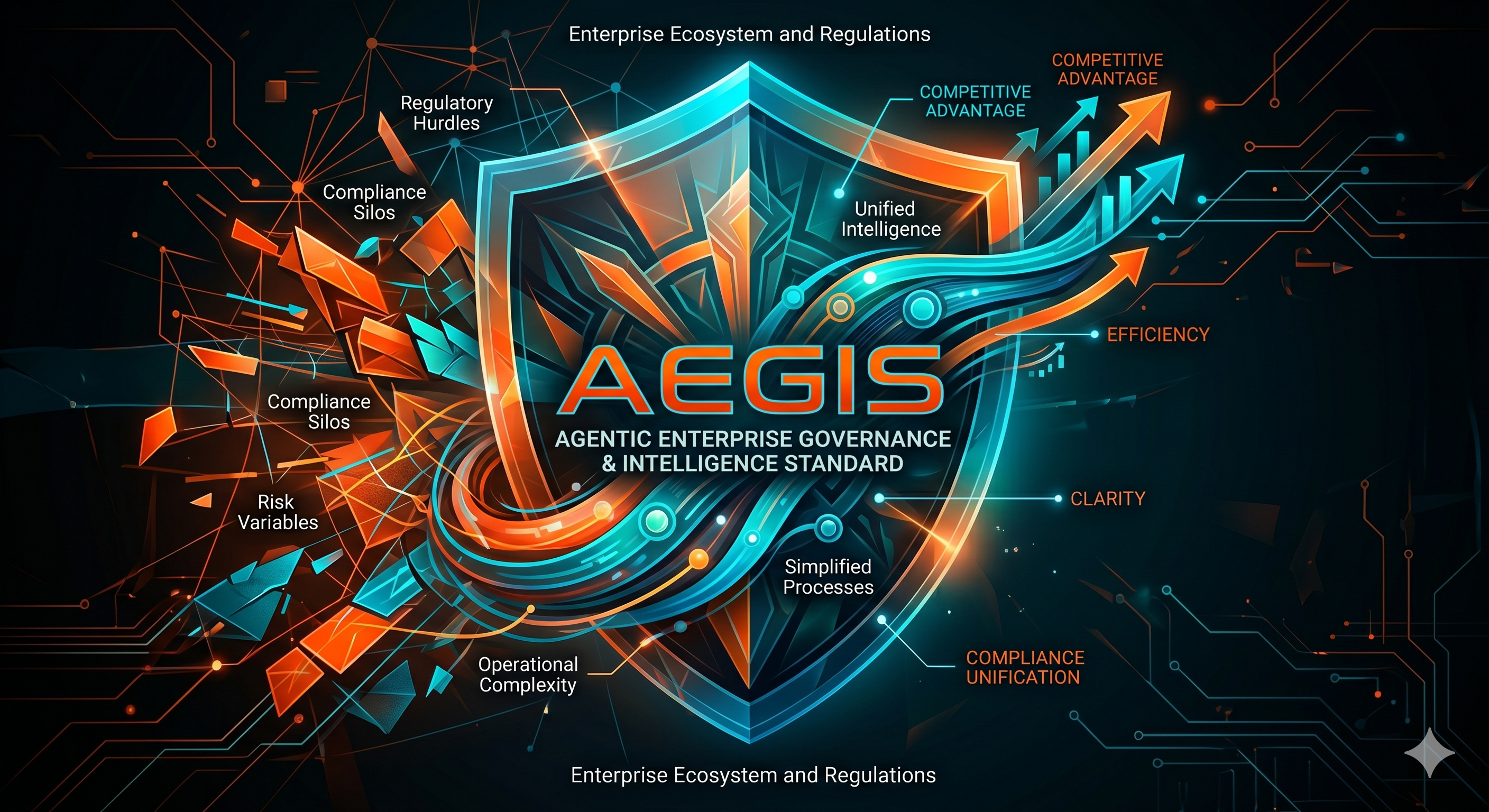
Ariana.Digital · AEGIS Framework · Solutions Architecture

Agentic AI for Regulated Industries
AEGIS Governance and Technology Architecture

For each industry subsector and operating function: AEGIS pillar activation, regulatory obligations, practical governance considerations, and a concrete frontier model and enterprise platform architecture for the reimagined agentic service flow.

Financial Services Healthcare Manufacturing Claude Opus 4.8 · GPT-5.5 · Gemini 3.1 Pro · NVIDIA NIM ServiceNow · Salesforce Agentforce 360 · Databricks Mosaic AI · Snowflake Cortex AI · Microsoft Azure AI Foundry · Adobe AEGIS 7 Pillars
Ariana.Digital
AEGIS Framework
Updated June 2026

Roadmap watch : what is not yet GA

Every model and platform named in the architecture below is generally available as of June 2026 unless tagged otherwise. These items are tracked but not yet recommended for production architecture.

Roadmap · Frontier Models
OpenAI GPT-5.6

Rumored late June 2026 with a 1.5M token context window. No system card published. Treat as roadmap until OpenAI publishes benchmarks. GPT-5.5 remains the production model.

Roadmap · Frontier Models
Google Gemini 3.5 Pro

Previewed at Google I/O on May 19, 2026, still limited preview as of mid-June. Targeted GA in June with Deep Think mode. Use Gemini 3.1 Pro and Gemini 3.5 Flash for production today.

Not Available · Export Control
Claude Fable 5 / Mythos 5

Mythos-class models above Opus. Access suspended June 12, 2026 under a US government export-control directive. Architect against Claude Opus 4.8 and Sonnet 4.6 instead.

🏦

Financial Services

The most regulated AI deployment context in the US and EU. Every consequential decision: lending, investment, insurance, fraud: triggers overlapping federal and state disclosure, fairness, and explainability obligations.

Subsector 01

Retail and Consumer Banking

Credit Underwriting and Lending Decisions
P2 P3 P4 P5 P6 CFPB · CO SB 26-189 · ECOA · EU AI Annex III High Risk
⚙ Traditional Flow
  • Application intake via branch or portal
  • Credit bureau pull, FICO scoring
  • Underwriter manual review for exceptions
  • Approval or denial issued with templated letter
  • Adverse action notice generated manually, batch
  • Portfolio monitoring on monthly cycle
▸ Agentic Reimagined
  • Intake agent enriches each application with alternative data: cash flow, rent, utilities: within seconds of submission
  • Underwriting agent runs dynamic affordability modeling across multiple product structures, generates conditional approval packages with rate rationale
  • Compliance agent auto-generates CFPB-compliant adverse action notices with plain-language, jurisdiction-specific explanation; logs every decision with full audit trail
  • Portfolio monitoring agent flags early default signals in approved loans, triggers proactive workout outreach via Salesforce
  • All high-risk, edge-case, or high-value decisions route to human underwriter via HITL gate with pre-packaged review brief
Resource, Cost, and Benefit Analysis
Traditional Flow
Cycle time3 to 5 business days per application, longer for exceptions
LaborUnderwriter touches nearly every file; manual adverse-action drafting
Cost / decision$40 to $75 fully loaded for standard files
ThroughputCapped by underwriter headcount; queues build in peak demand
Agentic Reimagined
Cycle timeMinutes for standard files; humans see only edge cases
LaborUnderwriters reviewing ~15 to 25% of volume via HITL gate
Cost / decision$6 to $14 incl. model, orchestration, and audit logging
ThroughputElastic; scales with demand without linear hiring
70-85%
Decision time reduction
3-5x
Underwriter leverage
$25-50
Cost saved / decision
4-7x
Debt if ungoverned
Cost to govern: bias-audit of the full pipeline, OCC SR 11-7 model validation, immutable decision logging, and per-agent token caps add roughly 8 to 14% to run-cost. This is the price of the savings being defensible under CFPB and Colorado SB 26-189 examination. Figures illustrative; validate against your file mix and rate of exceptions.
AEGIS Pillar Activation and Governance Considerations
P2 AI Inventory: Consequential-Decision Tag P3 Bias Audit: ECOA 80% Rule P4 HITL Gates: High-Value and Edge Cases P5 CFPB Adverse Action Notices P5 CO SB 26-189 Disclosure Jan 2027 P6 Drift Monitoring: Bias and Accuracy
Critical considerations: Credit decisions are a primary target for CFPB adverse action enforcement and Colorado's SB 26-189 ADMT disclosure regime (effective Jan 1, 2027). The agentic flow must produce an explainable decision record: not just a score. Every agent action in the underwriting chain must be logged with intent, data accessed, and decision rationale in an immutable trail (P6). The pre-deployment bias audit must test the full agentic pipeline, not just the underlying model, because the enrichment agent introduces new data sources that may carry their own disparate-impact risk (P3). EU Annex III conformity assessment required if any EU applicants are processed.
Solutions Architecture: Frontier Models and Enterprise Ecosystems
Reasoning and Decisioning
  • Claude Sonnet 4.6: complex underwriting reasoning, conditional offer generation, adverse action narrative drafting
  • OpenAI GPT-5.5: alternative data synthesis, structured output for core banking system ingestion; current frontier model (April 2026)
Agent Orchestration
  • Microsoft Copilot Studio + Azure AI Foundry: orchestrates multi-step underwriting workflow; HITL routing to human underwriter queue; multi-model support including Claude, Gemini, and GPT-5.5
  • Microsoft Azure AI Foundry: agent deployment, versioning, model catalog access, and cost governance controls
Data and Feature Store
  • Databricks Mosaic AI: alternative credit feature engineering, model training, MLflow model registry, Unity Catalog for end-to-end data and AI lineage
  • Snowflake Cortex AI: portfolio data warehouse, real-time AISQL inference for drift scoring, Horizon Catalog for governance
CRM and Workflow
  • Salesforce Agentforce 360: portfolio monitoring alerts, proactive workout outreach; Atlas Reasoning Engine for hybrid reasoning, Agent Script for deterministic control over consequential decisions, Einstein Trust Layer for PII guardrails
Governance and Bias Control
  • Credo AI: pre-deployment bias audit registry, 80% rule monitoring
  • NVIDIA NeMo Guardrails: content safety NIM, topic control NIM, and jailbreak detection NIM microservices for output filtering, adverse language detection, and prohibited outputs
Document and Communication
  • Adobe Acrobat Sign and Adobe Document Cloud: adverse action notice generation, e-signature for conditional offers, document audit trail, AI Assistant for plain-language disclosure drafting
Model Risk: OCC SR 11-7 model validation required for agentic underwriting pipeline Explainability: LIME or SHAP required at decision level, not just model level EU Annex III: Conformity assessment required if EU applicants processed; deferred to Dec 2027 Cost Gov: Per-agent token budget caps to prevent runaway enrichment calls
Customer Onboarding and KYC / AML
P2 P3 P4 P5 P6 FinCEN · OFAC · GDPR Art.22 · EU AI Annex III High Risk
⚙ Traditional Flow
  • Document collection via branch or digital portal
  • Manual identity verification, batch AML screening
  • Compliance sign-off, account opening delayed 2–5 days
  • Welcome communications sent batch
  • High false-positive rate burdens compliance staff
▸ Agentic Reimagined
  • Identity agent orchestrates document ingestion, real-time biometric verification, and liveness detection in a single session
  • AML agent screens against live OFAC, PEP, and adverse media lists continuously; scores transaction risk using entity-relationship graph analysis
  • Risk scoring agent synthesizes identity confidence, AML risk, and source-of-wealth signals into a tiered risk classification with documented rationale
  • Exceptions and elevated-risk profiles routed to compliance officer via ServiceNow case queue with complete evidence package
  • Auto-populates core banking and CRM; triggers welcome workflow in Salesforce
Resource, Cost, and Benefit Analysis
Traditional Flow
Cycle time2 to 5 days to open; manual identity and watchlist checks
LaborAnalysts clear high false-positive AML alert queues by hand
Cost / case$15 to $40 for standard onboarding; far higher for EDD
False positives90%+ of AML alerts are false; analyst time consumed
Agentic Reimagined
Cycle timeSame session for low-risk; continuous re-screening
LaborAnalysts focus on genuinely elevated profiles only
Cost / case$3 to $9 for low-risk straight-through cases
False positivesMaterially lower via entity-graph context scoring
60-80%
Faster account opening
40-60%
Fewer false positives
2-4x
Analyst productivity
100%
Decisions audit-logged
Cost to govern: sanctions-screening accuracy is regulator-facing, so every automated clear or escalate needs a logged rationale and periodic model validation. Under-investing here trades a compliance-cost saving today for BSA/AML enforcement exposure later. Ranges are illustrative; calibrate to your risk appetite and regulator expectations.
AEGIS Pillar Activation and Governance Considerations
P2 AI Inventory: AML System Classification P3 Bias Audit: Identity Verification Equity P4 HITL: Elevated Risk Escalation P5 GDPR Art.13/14 Privacy Notice P6 Immutable AML Decision Log
Critical considerations: Identity verification AI carries documented demographic performance disparities: darker skin tones and non-Western document formats consistently underperform. A P3 bias audit across these dimensions is non-negotiable before production deployment. The AML graph agent has write access to account status and must have strict action allowlists (P4): it can flag, never block, without HITL review above a defined risk threshold. GDPR Article 13/14 privacy notices must disclose automated profiling at point of data collection (P5).
Solutions Architecture: Frontier Models and Enterprise Ecosystems
Core AI Models
  • Google Gemini 3.1 Pro: multimodal document understanding, passport / ID card extraction across 190+ document types
  • NVIDIA NIM (RAPIDS): graph neural network for entity relationship and AML pattern detection at scale
Agent Orchestration
  • ServiceNow AI Platform: KYC case management, exception workflows, compliance officer queue
  • Microsoft Azure AI Foundry: identity agent deployment with session-scoped credentials
Data Infrastructure
  • Snowflake Cortex AI: watchlist data federation, entity resolution, customer risk score store
  • Databricks Mosaic AI: AML graph analytics, behavioral feature engineering, Unity Catalog lineage
Document and Comms
  • Adobe Document Cloud: digital onboarding forms, GDPR consent capture, e-signature
  • Salesforce Agentforce 360: welcome journey, next-best-product recommendations post-onboarding
Subsector 02

Wealth Management and Private Banking

Portfolio Management, Rebalancing, and Financial Planning
P1 P2 P3 P4 P5 SEC Reg BI · MiFID II · FINRA · EU AI Annex III High Risk
⚙ Traditional Flow
  • Annual or quarterly advisor review meetings
  • Manual portfolio drift analysis in spreadsheet or PMS
  • Compliance pre-trade check, client approval, execution
  • Financial plan built in a single engagement session, delivered as static PDF
▸ Agentic Reimagined
  • Monitoring agent tracks all client portfolios continuously against IPS parameters; surfaces drift alerts ranked by materiality and client impact
  • Planning agent ingests life-event triggers (job change, inheritance, property purchase) and dynamically updates a living financial plan accessible to advisor and client
  • Rebalancing agent models tax-efficient trade options across multiple scenarios; generates plain-language proposal with full rationale for advisor review before any execution
  • All trade recommendations require advisor confirmation; client consent required for execution above defined thresholds (P4 HITL)
  • Macro signal agent surfaces regime-change alerts and flags IPS review to advisor with supporting market context
Resource, Cost, and Benefit Analysis
Traditional Flow
CadenceQuarterly or annual reviews; plans go stale between touches
LaborAdvisor manually models scenarios and prepares Reg BI files
CoverageHigh-net-worth clients served; mass-affluent under-served
Cost / planHigh advisor hours per comprehensive plan
Agentic Reimagined
CadenceContinuous monitoring; plan updates on life and market events
LaborAdvisor reviews agent-prepared recommendations and signs off
CoverageMass-affluent served profitably at scale
Cost / planSharp reduction in advisor hours per plan
3-5x
Clients per advisor
50-70%
Less prep time
24/7
Plan monitoring
100%
Reg BI steps logged
Cost to govern: Agent Script must enforce Reg BI best-interest checks as deterministic steps before any recommendation surfaces, and every suitability decision needs a record. The governance layer is what lets you expand coverage without expanding fiduciary risk. Illustrative ranges; depends on book composition and product complexity.
AEGIS Pillar Activation and Governance Considerations
P1 AI Use Policy: Investment Advice Scope P2 Inventory: Consequential-Decision Classification P4 HITL: All Trade Execution P5 Reg BI Best Interest Disclosure P6 Model Performance and Drift Monitoring
Critical considerations: SEC Regulation Best Interest requires the advisor's recommendation to reflect the client's best interest: AI-generated proposals do not satisfy this obligation on their own. The governance architecture must clearly position the agent as advisor support, not advice replacement (P1 AI Use Policy). Every rebalancing recommendation must carry an explainable rationale traceable to IPS parameters (P5). The planning agent's access to account data must be scoped to read-only; write access only activates on confirmed advisor instruction (P4 action allowlist). MiFID II requires record of every recommendation for 5 years; the immutable audit trail (P6) satisfies this.
Solutions Architecture: Frontier Models and Enterprise Ecosystems
Reasoning Models
  • Claude Sonnet 4.6: financial plan narrative generation, scenario explanation, client-facing communication drafting
  • OpenAI GPT-5.5 Pro: portfolio optimization reasoning, multi-constraint tax-lot modeling, deeper agentic reasoning for complex constraint problems
Data and Quant Layer
  • Snowflake Cortex: portfolio analytics, performance attribution, real-time market data integration
  • Databricks Mosaic AI: factor model training, alternative data ingestion, scenario simulation
Advisor Workflow
  • Salesforce Financial Services Cloud + Agentforce: living financial plan surface, HITL recommendation review, client engagement tracking
  • Microsoft Copilot Studio: advisor co-pilot for real-time portfolio Q&A and client meeting prep
Client Communications
  • Adobe Express / Document Cloud: personalized portfolio reports, scenario illustrations, Reg BI disclosure documents with e-signature
Subsector 03

Insurance

Claims Processing, Settlement, and Fraud Detection
P2 P3 P4 P5 P6 State Insurance Regs · CO SB 26-189 · EU AI Annex III · GDPR High Risk
⚙ Traditional Flow
  • Claim filed; adjuster assigned 1–3 days later
  • Investigation over days to weeks; manual coverage determination
  • Settlement offer generated; disputes managed via phone
  • Fraud detection rule-based, high false positive burden on analysts
▸ Agentic Reimagined
  • Triage agent scores claim complexity and fraud probability at submission; auto-assigns routing: straight-through processing, field inspection, or SIU referral
  • Adjudication agent applies coverage logic with documented policy interpretation; auto-settles clear-cut claims within defined parameters; drafts settlement letters with plain-language rationale
  • Fraud detection agent correlates network relationships, device signals, behavioral anomalies, and claim history; flags high-confidence fraud with a structured investigation brief
  • All denials, borderline settlements, and fraud referrals require human senior adjuster review (P4 HITL) before any adverse action is communicated to claimant
Resource, Cost, and Benefit Analysis
Traditional Flow
Cycle timeDays to weeks; manual adjuster review and SIU referral
LaborAdjusters triage every claim; fraud caught reactively
Cost / claimHigh adjuster loaded cost; leakage from missed fraud
Fraud catchLimited to flagged patterns; sophisticated rings slip through
Agentic Reimagined
Cycle timeHours for clean claims; straight-through settlement
LaborAdjusters focus on complex and disputed claims
Cost / claimLower loaded cost; reduced leakage
Fraud catchNetwork-graph detection surfaces organized fraud
50-75%
Faster settlement
20-40%
Less fraud leakage
2-4x
Adjuster leverage
100%
Denials with rationale
Cost to govern: automated denials are a bad-faith and unfair-claims-practice risk, so each must carry a documented basis and route through a HITL gate. The savings only hold if the denial trail survives regulator and litigation scrutiny. Figures illustrative; calibrate to line of business and jurisdiction.
AEGIS Pillar Activation and Governance Considerations
P3 Bias Audit: Claim Outcome Equity P4 HITL: All Denials and SIU Referrals P5 CO SB 26-189 Adverse Decision Notice P5 Claimant Right to Human Review P6 Fraud Model Drift Monitoring
Critical considerations: Claims denial is an ADMT trigger under Colorado SB 26-189 (Jan 2027) and state insurance regulations in several jurisdictions: a structured adverse action notice with a meaningful human review pathway is legally required (P5). The fraud detection agent must never communicate a fraud accusation to a claimant; it is a referral tool only, with HITL required before any adverse action (P4). Claim outcome bias audits must test across race, gender, geography, and claim type: courts have found algorithmic claim steering to constitute unfair discrimination (P3).
Solutions Architecture: Frontier Models and Enterprise Ecosystems
Core Models
  • Gemini 3.1 Pro: multimodal claims intake: photo damage assessment, document understanding, medical record extraction
  • Claude Sonnet 4.6: coverage reasoning, settlement letter drafting, claimant communication
  • NVIDIA NIM (RAPIDS cuGraph): fraud network graph analytics, entity relationship scoring
Case Management
  • Salesforce Financial Services Cloud: claims workflow, adjuster queue, SIU referral management
  • ServiceNow: HITL escalation routing, SLA monitoring, audit trail case management
Analytics and Fraud
  • Databricks Mosaic AI: fraud model training, claim enrichment pipeline, Unity Catalog for evidence lineage
  • Snowflake Cortex AI: claims data warehouse, network analytics, regulatory reporting
Communication and Documents
  • Adobe Document Cloud: settlement documents, denial notices with required disclosures, signed releases
🏥

Healthcare

The intersection of FDA SaMD regulation, HIPAA data obligations, EU AI Act Annex III high-risk classification, and clinical liability creates the most complex AI governance environment of any sector.

Subsector 01

Hospital Systems and Acute Care

Clinical Decision Support and Care Coordination
P1 P2 P3 P4 P5 P6 FDA SaMD · HIPAA · EU AI Annex III · ONC HTI-1 Critical Risk
⚙ Traditional Flow
  • Clinician reviews chart manually; consults reference databases
  • Clinical decision documented in EHR; orders entered separately
  • Care coordination by phone and fax across departments
  • Discharge planning reactive; delays common and costly
▸ Agentic Reimagined
  • Clinical surveillance agent monitors real-time vitals, labs, medication, and imaging streams; surfaces ranked, evidence-based alerts at point of care
  • Differential support agent synthesizes patient history, current presentation, and literature to offer diagnostic hypotheses with supporting citations: physician decides and documents
  • Discharge planning agent tracks clinical trajectory, predicts readiness 48–72 hours in advance, proactively initiates referrals to appropriate post-acute settings
  • Order entry agent translates clinical decision into structured order set suggestions; clinician reviews and approves every order: no autonomous ordering (P4 HITL always)
  • Full immutable action log: alert surfaced, clinician response, order, outcome (P6)
Resource, Cost, and Benefit Analysis
Traditional Flow
LatencyClinician synthesizes records manually; gaps at handoff
LaborCare coordination is phone-and-fax heavy, time-intensive
CoverageRisk stratification on periodic, retrospective basis
DocumentationManual note-taking; clinician burnout and time drain
Agentic Reimagined
LatencyReal-time synthesis surfaced at point of care
LaborCoordination tasks drafted by agents, clinician approves
CoverageContinuous risk stratification across the panel
DocumentationAmbient draft notes; clinician reviews and signs
30-50%
Less admin time
24/7
Panel monitoring
100%
MD sign-off enforced
Higher
Care-gap closure
Cost to govern: clinical AI is high-risk. A clinician must remain the decision-maker (P4 HITL), recommendations need ONC algorithm-transparency disclosure, and PHI handling stays inside HIPAA boundaries. Governance here is patient-safety infrastructure, not overhead. Ranges illustrative; depends on specialty and EHR integration depth.
AEGIS Pillar Activation and Governance Considerations
P1 AI Use Policy: Clinical Scope Definition P2 Inventory: FDA SaMD Classification P3 Clinical Validation: Diverse Populations P4 HITL: Every Clinical Order, Always P5 ONC HTI-1 Algorithm Transparency P6 Post-Market Surveillance: FDA Requirement FDA Pre-Sub + 510(k) Pathway
Critical considerations: Clinical decision support that drives diagnosis, treatment, or triage is a Software as a Medical Device under FDA guidance. A pre-submission meeting with FDA and 510(k) clearance pathway must be established before any deployment (P1 governance architecture includes regulatory classification). Clinical validation across diverse patient populations: race, age, sex, comorbidity profiles: is non-negotiable; demographic performance disparities in clinical AI are well-documented and constitute a P3 obligation. ONC's HTI-1 rule (2024) requires algorithm transparency for any decision support influencing EHR-based care. HIPAA-compliant data use agreements are required before any PHI is used in agent training or runtime enrichment. Post-market surveillance is an FDA requirement, not optional: map directly to P6 monitoring cadences.
Solutions Architecture: Frontier Models and Enterprise Ecosystems
Clinical Reasoning Models
  • Claude Sonnet 4.6: clinical narrative synthesis, differential hypothesis generation, discharge summary drafting; strong structured output discipline
  • Google Gemini 3.1 Pro: multimodal: radiology image analysis, pathology slides, EHR document understanding
  • NVIDIA NIM (BioNeMo): specialized clinical models: genomics, drug interaction, sepsis early warning via NVIDIA AI Blueprint
Clinical Data Platform
  • Databricks Mosaic AI: FHIR data lakehouse, clinical feature engineering, model validation across patient cohorts, HIPAA-compliant environment
  • Snowflake Health Data Cloud: federated PHI analytics, interoperability with Epic/Cerner, real-time Cortex inference
Workflow and Care Coordination
  • ServiceNow Healthcare: care coordination workflows, discharge planning case management, HITL escalation queues, audit trail case records
  • Microsoft Azure Health Data Services: FHIR API layer, de-identification, agent-to-EHR integration
Patient Communication
  • Adobe Experience Cloud: patient-facing discharge instructions, personalized care plan documents, ONC-compliant algorithm disclosure notices
Governance Layer
  • Credo AI: FDA post-market surveillance framework, bias monitoring dashboard, model card registry
  • Microsoft Purview: PHI access audit, data lineage, HIPAA compliance controls
FDA SaMD: Intended use statement determines regulatory pathway; any diagnostic influence = Class II minimum HIPAA: BAA required with every AI vendor; PHI in prompt context requires special handling Liability: Physician override capability and immutable audit log are the primary malpractice defense EU Annex III: Healthcare AI is named high-risk; conformity assessment required by Dec 2027
Revenue Cycle Management and Medical Coding
P2 P3 P4 P5 P6 HIPAA · CMS Coding Regs · CFPB (Patient Billing) · State Surprise Billing Medium-High Risk
⚙ Traditional Flow
  • Coders manually review notes; assign ICD/CPT codes
  • Claims submitted; denial rates 5–10% typical
  • Manual appeals process, slow and resource-intensive
  • Underpayment patterns identified reactively
▸ Agentic Reimagined
  • Coding agent reads clinical documentation in real time; proposes accurate ICD/CPT codes with evidence citations from the note
  • Pre-submission agent flags documentation gaps before claim is submitted; requests addendum from clinician via EHR inbox
  • Denial management agent auto-generates payer-specific appeals with supporting clinical rationale; tracks payer behavior patterns for systematic underpayment detection
  • Patient billing agent generates plain-language Explanation of Benefits; routes billing disputes to human financial counselor with case brief
  • All coding decisions carry coder review queue for complex cases; full audit trail of agent-proposed vs. coder-confirmed codes
Resource, Cost, and Benefit Analysis
Traditional Flow
Cycle timeDays to code and submit; denial rework loops
LaborCoders manually assign codes; billers chase denials
Denial rateSignificant first-pass denials drive costly rework
Cost / claimHigh coding and rework labor per encounter
Agentic Reimagined
Cycle timeSame-day coding and clean-claim submission
LaborCoders audit and approve agent-suggested codes
Denial rateLower first-pass denials via pre-submission checks
Cost / claimReduced labor; faster cash collection
40-60%
Faster submission
15-30%
Fewer denials
2-3x
Coder leverage
Faster
Days-in-AR
Cost to govern: automated coding carries False Claims Act and upcoding exposure. Coder review of agent suggestions and an audit trail per code are mandatory controls. The efficiency gain is real only if coding integrity is provable. Illustrative ranges; validate against payer mix and specialty coding complexity.
AEGIS Pillar Activation and Governance Considerations
P2 Inventory: Coding AI Classification P4 Coder Review Queue: Exception Routing P5 Patient Billing Transparency: CFPB P6 Denial Rate Drift Monitoring
Critical considerations: Autonomous medical coding without clinical coder oversight creates False Claims Act exposure if it systematically upcodes or downcodes. The governance model must maintain coder-in-the-loop for complex and high-value encounters (P4). Denial trend monitoring (P6) is the mechanism for detecting systematic payer-side underpayment as well as agent coding error patterns. Patient-facing billing communications must meet plain-language and accessibility standards under CFPB guidance (P5).
Solutions Architecture
Coding and NLP
  • Claude Sonnet 4.6: clinical note understanding, ICD/CPT code rationale generation, appeal letter drafting
  • NVIDIA Llama Nemotron Super (fine-tuned): high-volume coding inference on-premise, deployed via NVIDIA NIM microservices for HIPAA boundary compliance and zero data egress
Workflow
  • ServiceNow: denial management workflow, appeal tracking, payer behavior analytics
  • Salesforce Health Cloud: patient financial counseling, billing dispute resolution
Analytics
  • Databricks Mosaic AI: denial pattern analysis, payer contract analytics, coding accuracy benchmarking
  • Snowflake Cortex AI: revenue cycle data warehouse, real-time claim status tracking
Patient Documents
  • Adobe Document Cloud: patient-facing EOB generation, plain-language billing statements, e-signature for financial agreements
Subsector 02

Payer and Health Insurance

Prior Authorization and Claims Adjudication
P2 P3 P4 P5 P6 CMS Prior Auth Rule 2024 · CO SB 26-189 · EU AI Annex III · HIPAA Critical Risk
⚙ Traditional Flow
  • Provider submits auth request; payer staff review clinical criteria manually
  • Decision in 3–14 days; frequent denials generate appeals
  • Claims adjudicated in batch; overpayment recovered reactively
  • Heavy administrative burden on both provider and payer
▸ Agentic Reimagined
  • Authorization agent ingests request with clinical documentation; applies evidence-based coverage criteria; checks alternative care pathways per clinical guidelines
  • Straightforward cases auto-approved in minutes with documented clinical rationale accessible to provider and patient
  • Clinically complex cases routed to medical director with a pre-structured review brief and recommended decision
  • Adjudication agent processes claims continuously; applies clinical and coding logic; auto-adjusts clear-cut errors with documented rationale
  • Payment integrity agent detects anomalous billing patterns across provider networks; flags potential fraud for Special Investigations Unit with structured case file
Resource, Cost, and Benefit Analysis
Traditional Flow
Cycle timeDays; provider abrasion and care delays
LaborNurses and medical directors review high volume by hand
ConsistencyVariability across reviewers; appeals overhead
Cost / caseHigh clinical-reviewer loaded cost per authorization
Agentic Reimagined
Cycle timeMinutes to hours for clear approvals
LaborMedical directors review denials and edge cases only
ConsistencyUniform criteria application, fully logged
Cost / caseLower reviewer cost on approvable cases
60-80%
Faster approvals
2-4x
Reviewer leverage
100%
MD sign-off on denials
Lower
Provider abrasion
Cost to govern: denial automation is the single most regulated step. Agent Script must make medical-director sign-off a hard precondition for any denial, with CO SB 26-189 compliant notices. State PA-reform laws and CMS interoperability rules raise the stakes. Figures illustrative; calibrate to plan type and state rules.
AEGIS Pillar Activation and Governance Considerations
P3 Bias Audit: Authorization Equity by Demographics P4 HITL: All Denials Require Medical Director Review P5 CMS Prior Auth Interoperability Rule P5 CO SB 26-189 Adverse Decision Notice Jan 2027 P6 Authorization Outcome Drift Monitoring EU Annex III: High-Risk AI Deferred Dec 2027
Critical considerations: This is one of the most legally exposed agentic use cases in healthcare. CMS's 2024 Prior Authorization Interoperability Rule mandates API-based prior auth decisions with explicit reasoning: the agentic system must produce a machine-readable, human-understandable rationale. Any AI-generated denial is a consequential decision under Colorado SB 26-189, requiring structured notice and human review pathway. The P3 bias audit must test authorization outcomes across race, ethnicity, geography, and condition type: documented disparities in AI prior auth have already triggered congressional scrutiny and class action litigation. All denials require medical director sign-off: this is a non-negotiable HITL gate (P4).
Solutions Architecture
Clinical AI Models
  • Claude Sonnet 4.6: clinical guideline reasoning, authorization rationale generation, provider-facing explanation drafting
  • NVIDIA NIM (BioNeMo): clinical NLP for medical record extraction at scale; deployed in HIPAA-compliant private cloud
Workflow and Case Management
  • Salesforce Health Cloud + Agentforce: authorization workflow, medical director review queue, member and provider portal
  • ServiceNow: SIU case management, compliance incident tracking, audit trail
Analytics
  • Databricks Mosaic AI: authorization outcome bias analytics, fraud model training, payment integrity pipeline
  • Snowflake Health Data Cloud: claims data warehouse, real-time adjudication analytics, network pricing
Member Communications
  • Adobe Experience Cloud: authorization decision notices, EOB documents, member-facing plain-language summaries, CO SB 26-189 compliant adverse action templates
Subsector 03

Life Sciences and Clinical Research

Clinical Trial Operations and Pharmacovigilance
P1 P2 P3 P4 P6 FDA 21 CFR Part 11 · ICH E6 GCP · EMA PV Regulations · GDPR Clinical High Risk
⚙ Traditional Flow
  • Trial coordinators manually screen EHR records against eligibility criteria
  • Adverse events gathered via manual intake and data entry
  • Safety narratives prepared by medical writers; periodic aggregate reports
  • Protocol deviations detected late; recruitment consistently misses targets
▸ Agentic Reimagined
  • Recruitment agent continuously monitors EHR data against protocol eligibility; identifies and alerts coordinators to eligible patients with a matching brief and consent workflow
  • Protocol monitoring agent tracks enrolled patients for deviations in real time; auto-generates protocol deviation narratives for IRB notification
  • Pharmacovigilance agent ingests adverse event reports, literature, and social media signals simultaneously; classifies by severity and causality; populates safety database; drafts ICSR narratives for regulatory submission
  • Signal detection agent monitors aggregate safety data for emerging signals that trigger expedited reporting; surfaces to medical safety officer with evidence package
Resource, Cost, and Benefit Analysis
Traditional Flow
SpeedManual eligibility screening; slow site and patient matching
LaborSafety teams manually triage adverse-event case volume
CoverageSignal detection on periodic batch cycles
CostHigh monitoring and case-processing labor under GxP
Agentic Reimagined
SpeedAccelerated eligibility matching against FHIR data
LaborSafety scientists review agent-triaged signals
CoverageContinuous signal monitoring across sources
CostReduced case-processing labor per ICSR
Faster
Trial enrollment
30-50%
Less triage labor
Continuous
PV signal scan
100%
GxP audit trail
Cost to govern: the AI system itself requires GxP validation (the platform being qualified is not enough), with 21 CFR Part 11 audit trails and human accountability for any safety determination. Skipping validation voids the savings and the submission. Ranges illustrative; depends on therapeutic area and trial phase.
AEGIS Pillar Activation and Governance Considerations
P1 AI Use Policy: GCP-Validated AI Systems P2 Inventory: 21 CFR Part 11 Classification P3 Trial Population Diversity Assessment P4 HITL: All Regulatory Submissions P6 Post-Market Signal Monitoring GxP Validation of AI Systems Required
Critical considerations: Any AI system used in GCP-regulated clinical trial operations must be validated under 21 CFR Part 11 and ICH E6 guidelines: a GxP validation protocol is a prerequisite for deployment, not a governance add-on (P1 AI Use Policy must specify GxP scope explicitly). The pharmacovigilance agent's ICSR output requires medical safety officer review before submission; autonomous regulatory filing by an AI agent is not acceptable (P4 HITL). The recruitment agent's access to PHI is governed by the trial's approved HIPAA authorization and IRB protocol: it cannot expand scope without protocol amendment.
Solutions Architecture
Core Models
  • Claude Sonnet 4.6: ICSR narrative generation, protocol deviation documentation, medical writing support
  • Gemini 3.1 Pro: literature surveillance, adverse event signal detection across unstructured sources
  • NVIDIA BioNeMo: genomics and biomarker analysis, molecular simulation support
Clinical Data
  • Databricks Mosaic AI: FHIR-based eligibility screening, trial data lake, GxP-validated compute environment
  • Snowflake Cortex AI: safety database integration, signal detection analytics, cross-trial aggregate reporting
Trial Operations
  • Salesforce Life Sciences Cloud: site and patient management, investigator communications, consent tracking
  • Microsoft Azure: GxP-validated cloud environment, 21 CFR Part 11 audit trail infrastructure
🏭

Manufacturing

Agentic AI in manufacturing operates at the intersection of OT/IT security boundaries, EU AI Act safety system obligations, ISO 42001 procurement requirements, and product liability risk. The governance stakes are physical as well as regulatory.

Subsector 01

Automotive and Transportation Equipment

Production Planning, Scheduling, and Supply Chain
P1 P2 P4 P6 EU AI Act Annex III · ISO 42001 · OT Security (NIST CSF) · Product Liability High Risk
⚙ Traditional Flow
  • MRP/ERP batch planning run weekly or monthly
  • Planners manually adjust for disruptions using judgment
  • Supply disruptions identified reactively when deliveries miss
  • Supplier performance reviewed on fixed quarterly cycles
▸ Agentic Reimagined
  • Demand sensing agent continuously ingests POS data, dealer inventory, order bank, and macroeconomic signals; dynamically updates the production forecast
  • Scheduling agent optimizes production sequence across constraints (tooling availability, workforce, sequencing rules); generates updated shift plans and surfaces impact of changes on customer delivery commitments
  • Supply risk agent monitors supplier financial health, capacity signals, logistics disruptions, and geopolitical risk; flags emerging risks 30–90 days before delivery impact with alternative sourcing brief
  • All decisions above defined financial thresholds or involving new supplier relationships require procurement manager review (P4 HITL); agent operates read-write within approved constraint boundaries only
Resource, Cost, and Benefit Analysis
Traditional Flow
ReplanningPeriodic; planners react to disruption after the fact
LaborPlanners manually model scenarios in spreadsheets and ERP
VisibilityLimited multi-tier supplier insight
CostExcess inventory and expedite costs from late reaction
Agentic Reimagined
ReplanningContinuous re-optimization on live signals
LaborPlanners approve agent-proposed schedule changes
VisibilityMulti-tier supplier risk surfaced proactively
CostLower inventory carry and expedite spend
20-40%
Less expedite cost
10-25%
Inventory reduction
Faster
Disruption response
Higher
Schedule adherence
Cost to govern: agents with ERP write access need spend-threshold guardrails, prohibited-counterparty blocking, and HITL approval above defined limits. The cost layer here is a circuit-breaker against a runaway agent committing real procurement dollars. Figures illustrative; validate against your ERP and supplier base.
AEGIS Pillar Activation and Governance Considerations
P1 AI Use Policy: Agentic Scope in ERP Systems P2 Inventory: OT/IT Boundary Classification P4 Action Allowlist: ERP Write Boundaries P4 Budget Cap: Per-Agent API Spend P6 Immutable Decision Log: Supply Decisions ISO 42001: Procurement Qualification
Critical considerations: The supply chain agent's write access to ERP purchase orders and scheduling systems is the primary governance risk: the $11M hallucinated contract scenario from the handbook is entirely real and entirely preventable with a properly governed action allowlist (P4). Transaction value thresholds, counterparty restrictions, and new vendor blocklists must be defined in code, not in policy documents. OT/IT security boundary is critical: the scheduling agent must be network-segmented from plant floor control systems: it sends recommendations to human schedulers, it never directly interfaces with PLCs or SCADA. ISO 42001 certification is increasingly a mandatory requirement in EU automotive and aerospace supply chain procurement: this is a P7 intelligence obligation and a direct revenue enabler.
Solutions Architecture
Reasoning and Planning
  • Claude Sonnet 4.6: supply risk synthesis, supplier brief generation, procurement recommendation narrative
  • OpenAI GPT-5.5 Pro: multi-constraint production scheduling optimization, scenario modeling
Enterprise Integration
  • SAP Joule + Azure AI Foundry: ERP-native AI agent layer; governed write access via SAP Business AI guardrails
  • ServiceNow: supply disruption case management, HITL procurement approval workflows, audit trail
Data and Analytics
  • Databricks Mosaic AI: demand forecasting models, supplier risk scoring, logistics disruption pattern analysis
  • Snowflake Cortex AI: supply chain data lakehouse, multi-tier supplier visibility, cost analytics
Governance Controls
  • NVIDIA NeMo Guardrails: ERP action filtering, spend threshold enforcement, prohibited counterparty blocking
  • Microsoft Purview: data lineage, access audit, immutable decision logging for procurement compliance
Quality Assurance, Defect Detection, and Predictive Maintenance
P2 P3 P4 P6 EU AI Act (Safety Systems) · ISO 9001 · Product Liability Directive · IATF 16949 High Risk
⚙ Traditional Flow
  • Statistical sampling at defined checkpoints
  • Manual visual inspection; defects detected late
  • Root cause analysis over days after defect escape
  • Maintenance on fixed time or usage cycles
▸ Agentic Reimagined
  • Vision inspection agent analyzes computer vision feeds continuously; detects defect signatures in real time; automatically quarantines affected components and halts the relevant station for human quality engineer review
  • Root cause agent correlates defect patterns across hundreds of process parameters; generates a structured root cause hypothesis with supporting statistical evidence for engineer sign-off before any process change
  • Predictive maintenance agent monitors equipment sensor streams; predicts time to failure with confidence intervals; optimizes maintenance scheduling; auto-generates work orders with parts lists: technician confirms before executing
  • No autonomous process parameter changes without quality engineer approval (P4 HITL); all quarantine actions are reversible and fully logged (P6)
Resource, Cost, and Benefit Analysis
Traditional Flow
InspectionSampling-based; defects escape between samples
LaborManual visual inspection; reactive maintenance
DowntimeUnplanned failures cause costly line stoppages
ScrapDefects caught late drive scrap and rework cost
Agentic Reimagined
Inspection100% inline visual inspection at line speed
LaborInspectors handle flagged exceptions; predictive alerts
DowntimeReduced via early failure-signal detection
ScrapLower via earlier defect capture
Higher
Defect catch rate
20-40%
Less downtime
15-30%
Scrap reduction
Sub-100ms
Edge inference latency
Cost to govern: for safety-relevant components, inspection decisions need traceability and human escalation paths; edge models require drift monitoring as conditions change. The governance keeps the quality record audit-ready for ISO 9001 and customer audits. Illustrative ranges; depends on part criticality and defect types.
AEGIS Pillar Activation and Governance Considerations
P2 Inventory: Safety-Critical AI Classification P3 Vision Model Validation: Defect Type Coverage P4 HITL: All Process Changes Require QE Approval P4 Quarantine Reversibility: Mandatory P6 Defect Escape Rate Monitoring EU AI Act: Safety Component Classification
Critical considerations: If the vision inspection system is used to approve components for safety-critical assemblies (brake systems, steering, airbags), it is an EU AI Act Annex III safety component by definition: full conformity assessment and technical documentation are required by December 2027. The governance model must clearly separate the agent's role: it detects and quarantines, it never approves. Approval is always a human quality engineer function (P4). The predictive maintenance agent's work order generation must not bypass the CMMS approval workflow: no autonomous dispatch to a technician without a human supervisor sign-off, particularly for safety-critical equipment. Model performance must be validated across all defect type categories in the production range: coverage gaps create product liability exposure.
Solutions Architecture
Computer Vision and Sensing
  • NVIDIA Metropolis + NIM: real-time manufacturing visual inspection at line speed; GPU inference at the edge for sub-100ms defect detection latency
  • Gemini 3.1 Pro: complex defect analysis requiring contextual interpretation beyond pure pattern matching
Process Intelligence
  • Claude Sonnet 4.6: root cause hypothesis narrative, maintenance work order generation, quality engineer briefing documents
  • Databricks Mosaic AI: sensor data streaming, failure mode pattern analysis, maintenance optimization models
Maintenance and QMS
  • ServiceNow: CMMS integration, maintenance work order HITL approval workflow, defect case management, audit trail
  • SAP (Plant Maintenance module via SAP Joule): work order creation, spare parts management, cost tracking
Analytics and Governance
  • Snowflake Cortex AI: quality data warehouse, OEE analytics, defect trend reporting for ISO 9001 audits
  • Credo AI: safety-critical AI model registry, conformity assessment evidence package, EU Annex III documentation
Subsector 02

Process Manufacturing (Chemical, Food, Pharma Manufacturing)

Batch Process Optimization and GxP Compliance
P1 P2 P3 P4 P6 FDA 21 CFR Parts 210/211 · EU Annex 11 · ISO 42001 · FSMA (Food) Critical Risk
⚙ Traditional Flow
  • Process engineers set parameters from historical recipes
  • Batch records completed manually or with basic automation
  • Deviations investigated reactively after batch completion
  • Audit preparation requires significant manual effort before inspections
▸ Agentic Reimagined
  • Process monitoring agent tracks all batch parameters continuously; detects drift from validated control strategy in real time; flags out-of-limit conditions with recommended human action within validated response time
  • Governed adjustment agent makes parameter adjustments within pre-approved GxP-validated operating ranges only; any adjustment outside validated range triggers immediate HITL escalation
  • Batch record agent auto-generates electronic batch records with complete parameter histories, deviation records, and operator attestation prompts: 21 CFR Part 11 compliant
  • Audit readiness agent maintains continuous audit readiness; assembles evidence packages on demand; retrieves specific records within minutes in response to inspector requests
Resource, Cost, and Benefit Analysis
Traditional Flow
OptimizationManual process tuning; capability drift between reviews
LaborOperators and QA manually compile batch records
DeviationsInvestigated reactively; slow closure cycles
CostHigh documentation labor under validated environment
Agentic Reimagined
OptimizationContinuous process-capability modeling
LaborQA reviews and attests agent-compiled records
DeviationsFaster root-cause surfacing and closure
CostReduced documentation labor per batch
Faster
Batch release
30-50%
Less doc labor
Faster
Deviation closure
100%
Part 11 audit trail
Cost to govern: the customer, not the cloud vendor, owns IQ/OQ/PQ validation of the AI system under FDA and EU Annex 11. Part 11 e-signature and immutable metadata are non-negotiable. Validation cost is the entry ticket, not optional overhead. Ranges illustrative; depends on product and process complexity.
AEGIS Pillar Activation and Governance Considerations
P1 AI Use Policy: GxP Validation Required P2 Inventory: 21 CFR Part 11 Classification P4 Validated Operating Range Boundaries P4 HITL: Any Out-of-Spec Action P6 Real-Time Process Parameter Audit Trail EU Annex 11: Computerized System Validation
Critical considerations: This is the most technically constrained agentic deployment context in manufacturing. GxP regulations require that any computer system influencing drug manufacturing be validated under a documented validation protocol: the AI agent is a computerized system subject to 21 CFR Part 11 (US) and EU Annex 11 (EU). The validation protocol must define the agent's approved action space, test its behavior across the full operating range and at boundaries, and document the validation evidence before deployment (P1). The agent must never adjust process parameters outside the validated design space without operator authorization: this is a HITL requirement embedded in the regulatory framework itself (P4), not just an AEGIS governance choice. Any deviation generates a mandatory investigation under 21 CFR 211.192.
Solutions Architecture
Process Intelligence
  • NVIDIA NIM (deployed on-premise): real-time sensor inference within OT boundary; no cloud egress of process data for GxP compliance
  • Claude Sonnet 4.6: deviation narrative generation, CAPA report drafting, inspector response documents
Validated Data Infrastructure
  • Databricks (GxP-validated environment): batch analytics, process capability modeling, validated compute with IQ/OQ/PQ documentation support
  • Snowflake Cortex AI: quality data warehouse, cross-batch trend analytics, regulatory reporting
Compliance Workflow
  • ServiceNow: deviation management, CAPA workflow, inspection readiness case management, 21 CFR Part 11 audit trail
  • SAP Joule (ERP integration): batch record creation, material movement, quality holds
Document and Evidence
  • Adobe Document Cloud: 21 CFR Part 11 compliant e-signature for batch records, operator attestation, deviation closure; audit-ready document packages with immutable metadata
  • Microsoft Azure (GxP-validated regions): validated cloud infrastructure, audit trail storage, access control
GxP Validation: Full IQ/OQ/PQ required for every AI system in regulated manufacturing; no shortcuts 21 CFR Part 11: Electronic records and signatures: agent-generated batch records must meet all requirements EU Annex 11: Computerized system validation protocol required for EU market manufacturing Model Lock: Model version must be frozen in validated state; updates require re-validation
Subsector 03

Electronics and Semiconductor Manufacturing

Yield Management, Process Optimization, and New Product Introduction
P2 P3 P4 P6 EU AI Act · ISO 42001 · CMMC (Defense Supply Chain) · Export Controls (EAR/ITAR) Medium-High Risk
⚙ Traditional Flow
  • Yield data analyzed in batch by process engineers
  • Root cause analysis manually over days; next-cycle adjustment
  • NPI process transfer managed from historical engineering knowledge
  • Yield learning curve slow due to manual iteration cycles
▸ Agentic Reimagined
  • Yield analysis agent correlates yield outcomes with hundreds of process parameters in real time; identifies statistically significant signals associated with yield loss; generates structured root cause hypotheses for engineer review
  • Process optimization agent recommends parameter adjustments within the approved process design space; models predicted yield impact; routes all recommendations through process engineer approval before any fab action
  • NPI transfer agent systematically compares development and production process data; identifies parameters with statistically different distributions; flags transfer risks before qualification runs begin with a structured risk brief
  • Equipment health agent monitors fab equipment sensor streams; predicts maintenance events; optimizes chamber scheduling to minimize tool downtime impact on yield
Resource, Cost, and Benefit Analysis
Traditional Flow
Yield rampSlow root-cause analysis across many process layers
LaborProcess engineers manually correlate fab and supplier data
NPI speedLong new-product introduction learning cycles
CostYield loss and engineer hours during ramp
Agentic Reimagined
Yield rampFaster multi-layer root-cause via correlation agents
LaborEngineers approve agent-surfaced hypotheses
NPI speedCompressed learning cycles on new products
CostLower yield loss; engineer time refocused
Faster
Yield ramp
Higher
Mature yield
2-3x
Engineer leverage
On-prem
IP-safe deployment
Cost to govern: yield models embed trade-secret process IP, so on-premise deployment and export-control-aware data handling are required, with model-registry approval workflows for any change. Governance here protects the IP that the savings depend on. Figures illustrative; validate against node and process maturity.
AEGIS Pillar Activation and Governance Considerations
P2 Inventory: Yield AI System Classification P4 Process Change HITL: Engineer Sign-off Always P4 Design Space Boundary Enforcement P6 Yield Trend and Model Drift Monitoring CMMC Level 2/3 for Defense Programs Export Controls: AI Model Access Restrictions
Critical considerations: Semiconductor process AI that influences decisions on advanced nodes may trigger export control considerations if the model itself embodies controlled technology: legal review of EAR/ITAR applicability is required before deploying proprietary process models in cloud environments with potential foreign national access. For defense supply chain customers, CMMC Level 2 or 3 compliance may apply to the AI infrastructure. The process optimization agent must operate within a formally documented process design space: recommendations outside this space are automatically escalated to a senior process engineer, never executed autonomously (P4). Yield model drift monitoring (P6) must detect both performance degradation and concept drift as process conditions evolve over tool lifetime.
Solutions Architecture
Process AI Models
  • NVIDIA NIM + Modulus: physics-informed neural networks for process modeling; GPU-accelerated virtual metrology; deployed on-premise for IP and export control compliance
  • Databricks (MLflow): yield model training, experiment tracking, model registry with process engineer approval workflow
Engineering Workflow
  • Claude Sonnet 4.6: root cause hypothesis narrative, NPI risk brief generation, process characterization report drafting
  • ServiceNow: engineering change order workflow, HITL approval routing, corrective action tracking
Data and Analytics
  • Snowflake Cortex AI: fab data warehouse, multi-layer yield analytics, supplier material correlation
  • Databricks Mosaic AI: real-time sensor streaming, statistical process control, virtual metrology models
Governance and Security
  • Microsoft Azure Government / GovCloud: CMMC-compliant infrastructure for defense programs
  • Credo AI: AI system registry, process model governance, bias and performance monitoring
Current Capability Reference · June 2026

What is generally available today

Every name in the architecture above is a production-ready capability as of June 2026, unless flagged in the Roadmap Watch. Use this reference legend to verify against vendor product pages before contracting.

Frontier AI Models · GA
  • Claude Opus 4.8 (May 28, 2026) · Opus-class flagship, 1M token context, default for high-stakes agentic reasoning
  • Claude Sonnet 4.6 · production sweet spot at $3/$15 per million tokens, 200K standard / 1M beta context
  • Claude Haiku 4.5 · high-throughput classification and routing, $1/$5 per million tokens
  • OpenAI GPT-5.5 and GPT-5.5 Pro (April 23, 2026) · agentic coding leader, 82.7% on Terminal-Bench 2.0
  • Google Gemini 3.1 Pro (Feb 19, 2026) · reasoning leader at $2/$12, 1M token context, native multimodal
  • Google Gemini 3.5 Flash · GA default for AI Mode, Pro-level coding at Flash pricing
  • NVIDIA Nemotron (Nano / Super / Ultra) · deployable open models for on-premise agentic workloads via NIM
Enterprise Agentic Ecosystems · GA
  • Salesforce Agentforce 360 (Spring '26 GA) · Atlas Reasoning Engine, Agent Script for deterministic control, Data 360, Einstein Trust Layer
  • ServiceNow AI Platform · Now Assist, AI Agents, AI Agent Orchestrator for multi-agent routing across 450+ integrations
  • Microsoft Copilot Studio + Azure AI Foundry · multi-model agent platform with Claude, Gemini, and GPT-5.5 support
  • SAP Joule + Joule Agents · ERP-native agents inside S/4HANA via SAP AI Foundation
Data, Governance, and Documents · GA
  • Databricks Mosaic AI · Mosaic AI Agent Framework, MLflow 3.0, Unity Catalog, AI Gateway, Lakebase, Agent Bricks
  • Snowflake Cortex AI · Cortex AISQL, Horizon Catalog, Horizon Context, Cortex Search, Agentic Document Analytics
  • NVIDIA AI Enterprise · NIM microservices, NeMo Guardrails (content / topic / jailbreak), BioNeMo, Metropolis, RAPIDS
  • Microsoft Purview AI Hub · AI prompt and response audit, data lineage, DLP for AI
  • Credo AI · AI registry, EU AI Act conformity evidence, bias monitoring
  • Adobe Acrobat Sign + Document Cloud + Experience Cloud · 21 CFR Part 11 e-signature, document intelligence, regulated communications

Vendor product names, version numbers, and pricing tiers evolve quickly. This reference reflects vendor announcements and product documentation current to June 2026. Validate specific feature availability and data residency requirements with the vendor before contracting.