Loading regulatory ticker…
Home Services Digital Industry Journeys Governance Insights Book a diagnostic →
Regulatory clock ·

The deadlines already on your board's agenda.

Each one maps to a specific Governance SKU below. Click through to price the work that closes the gap.

AG enforcement paused

Colorado, USAColorado AI · SB 24-205 / SB 26-189

days · Jan 1, 2027 · SB 26-189

Pass: consequential-decision impact assessments, public risk statement, algorithmic-discrimination duty of care. Federal court stayed SB 24-205 AG enforcement (Apr 27, 2026); replacement SB 26-189 signed May 14 - confirm posture with counsel.

Map to G01 + G02
… days to deadline

European UnionAI Act · Article 50

days · Aug 2, 2026

Pass: disclose AI interactions, label synthetic / deepfake content, traceable system documentation. Art. 50(2) marking grace to 2 Dec 2026 for systems on market before 2 Aug 2026 (Digital Omnibus).

Map to G01 + G09
Examiners asking now

US Banks · InsurersSR 11-7 + OCC AI

Livein exam cycle

Pass: agent inventory, model-risk file per GenAI use, human oversight + logging, board attestation.

Map to G02 + G03
… days to deadline

California, USACCPA · ADMT

days · Jan 1, 2027

Pass: pre-use notice, opt-out for significant decisions (employment, credit, housing, health, education), access to ADMT logic + appeal rights.

Map to G02 + G08
… days to deadline

European UnionAI Act · High-risk

days · Aug 2, 2027

Pass: FRIA, risk mgmt system, human oversight, logging, conformity assessment, post-market monitoring.

Map to G04 + G05

Estimate builder

Estimate updates live as you select

Governance · reg-ready, before examiners ask

Six fixed-fee offerings mapped to the AI Act, Colorado, TRAIGA, ISO 42001, and SR 11-7. Sized to fit one budget cycle. Outputs you can hand to the board or a regulator.

Diagnose · know what to do

Before you spend another dollar. Fixed-fee, 2 - 4 week engagements. Most clients start here.

Build · ship what actually reaches production

Scoped, outcome-linked engagements. Complexity slider adjusts where in the range you land.

Run · AI rots in production. We keep yours sharp.

Pick one tier. Monthly retainer, 6 - 12 month minimum.

Verticals · pre-built for the work you can't wait on

Fixed package, 4 - 8 weeks to launch. Priced for speed.

Unified Enterprise AI Governance · May 2026

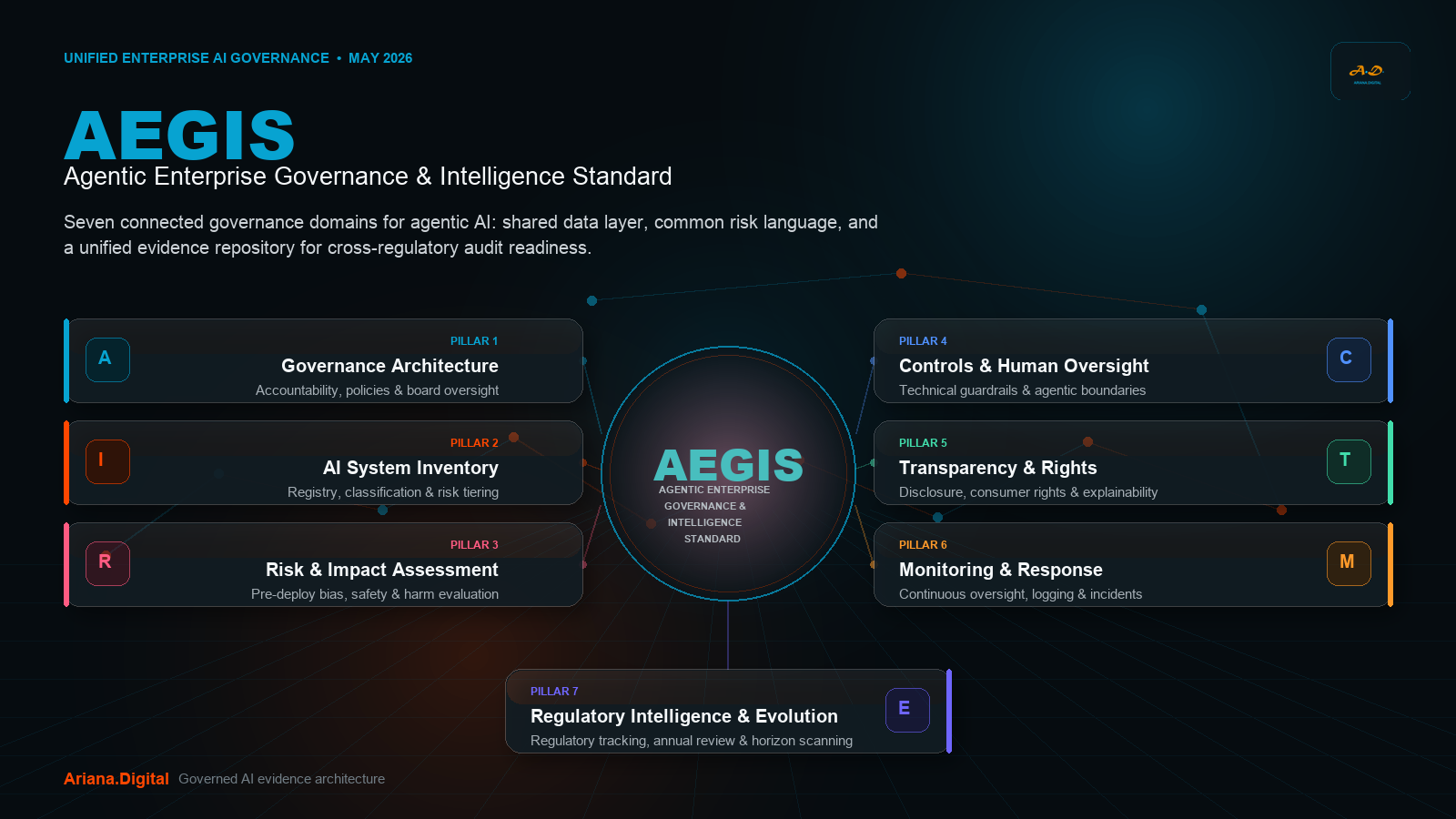
AEGIS

Agentic Enterprise Governance & Intelligence Standard

Each pillar addresses a distinct governance domain while interconnecting with all others through a shared data layer, common risk language, and unified evidence repository that satisfies cross-regulatory audit requirements simultaneously.

Get the AEGIS handbook

Work email unlocks the full Agentic Enterprise Governance & Intelligence Standard PDF on this page — 7 pillars, cross-regulatory matrix, agentic controls, cost governance, and 90-day roadmap.

G
Govern
Structure & accountability
I
Inventory
Know every AI system
A
Assess
Risk before deployment
C
Control
Guard & constrain
T
Transpar.
Disclose & explain
M
Monitor
Watch & respond
E
Evolve
Improve & track regs
Practical next steps

Primers for better Agentic Governance

Start with a diagnostic, staff the bench, or fix context and experience before you scale governed agentic systems.

Diagnose · 5 min

AI Transformation Readiness Diagnostic

Seven dimensions. Twenty-eight questions. Under five minutes. Benchmark your org against PwC, McKinsey, Deloitte, BCG, and Gartner 2026 research, then get a scored breakdown and priority actions you can fund this quarter.

ROI: Know which governance gap is blocking scale before you spend on pilots.

Take the diagnostic →
Build · Specialist bench

Contractor Pipeline · myndQ A-Team

Nine specialist roles for regulated work that ships in production: diagnostic leads, context engineers, agentic UX, MRM, and more. Remote-first, transparent day rates, vetted through talent.myndQ.ai.

ROI: Deploy governed agentic systems without a 12-month hiring cycle.

View open roles →
Run · 6-12 mo programs

AI Success Pack · Context + Experience

Forty-two percent of AI projects fail on missing context and unusable experiences. Two programs fix both: knowledge infrastructure and interaction design, the layers that determine whether AI delivers ROI in production.

ROI: Turn governance from compliance overhead into adoption and measurable value.

Explore programs →
Pillar detail

What each pillar requires you to do

Each card specifies the exact governance activities, the regulations it satisfies, agentic AI-specific controls, and the roles accountable.

Pillar 1 · Governance Architecture

Organizational Accountability & Policy

Build the organizational structure that makes AI governance real and defensible

NIST GOVERN EU AI Act Art. 9 & 26 ISO 42001 §5 - §6 OMB M-25-22 CO AI Act §4 FTC / SEC
Establish AI Governance Board (C-suite + Legal + Tech)
Appoint Chief AI Officer (CAIO) or equivalent role
Publish enterprise AI Use Policy (acceptable use, prohibited uses)
Create AI Ethics Charter aligned to OECD principles
Define RACI for every AI system lifecycle stage
Board-level AI risk reporting (quarterly minimum)
Annual AI governance program review
Vendor AI Governance Standard: require AI addenda in all third-party AI contracts (data usage restrictions, audit rights, incident notification SLAs)
Agentic AI: Define escalation thresholds - actions that require human approval before an agent executes. Document "human-in-the-loop" vs. "human-on-the-loop" per agent use case.
CEOCAIOGeneral CounselCISOBoard
Pillar 2 · AI System Inventory

AI Registry, Classification & Risk Tiering

You cannot govern what you cannot see - complete visibility is non-negotiable

NIST MAP EU AI Act Annex III ISO 42001 §8.4 CO AI Act CA ADMT
Maintain a live AI System Registry (centralized, version-controlled)
Capture per system: purpose, data types, affected populations, EU exposure
Classify risk tier: Prohibited / High / Limited / Minimal
Map to applicable regulations per system per jurisdiction
Tag consequential-decision systems (CO, CA, IL, EU definitions)
Include third-party / vendor AI in registry
Quarterly inventory refresh cycle
Track EU AI Database registration status
Agentic AI: Inventory must capture agent action scope (read/write/execute), autonomous decision boundaries, tool integrations, and data access permissions for each agent deployment.
CAIOEnterprise ArchitectBusiness Units
Pillar 3 · Risk & Impact Assessment

Pre-Deployment Risk, Bias & Safety Evaluation

Gate deployment on evidence of safety - not assumptions

NIST MEASURE EU AI Act Art. 9 - 11 GDPR DPIA ISO 42001 §8.4 CO AI Act CA ADMT Risk Assess. NYC LL144 Bias Audit IL AIVII
Algorithmic Impact Assessment (AIA) before every production deployment
Disparate impact analysis: 80% rule baseline across protected classes
Independent bias audit for employment AI (NYC mandate, IL best practice)
GDPR DPIA for any AI processing EU personal data
EU AI Act conformity self-assessment (Annex III) or notified body review
Red team adversarial testing (hallucination, jailbreak, data poisoning)
Safety benchmark testing vs. NIST MEASURE function criteria
Documented test results stored as audit evidence; re-assessment required on material model changes
Agentic AI: Test agent action chains for unintended cascades. Simulate adversarial prompts that attempt to override human-defined boundaries. Evaluate multi-agent interaction risks.
AI Risk TeamExternal AuditorLegal / Compliance
Pillar 4 · Controls & Human Oversight

Technical Safeguards, Guardrails & Human Gates

The technical implementation of governance - where policy becomes code

NIST MANAGE EU AI Act Art. 14 - 15 ISO 42001 §8.5 OMB M-25-22 Agentic TX TRAIGA Prohibitions EU Prohibited AI Art. 5
Deploy output guardrails on all production LLMs (content filtering, hallucination control)
Implement hard stops for EU AI Act prohibited practices (social scoring, manipulation)
Human approval gates for high-stakes AI decisions (loans, hiring, medical, legal)
Model drift detection with automatic alerting thresholds
Access control: least-privilege data access for all AI systems
Input sanitization and prompt injection defenses
Accuracy and robustness testing per EU AI Act Article 15
Override mechanisms: humans can always stop, correct, or override any AI decision. Documented procedure required.
Agentic AI: Define action allowlists (what the agent CAN do) and blocklists (what it CANNOT do). Implement "circuit breakers" - automatic agent pause when confidence falls below threshold or novel situation detected. Sandbox before production.
AI EngineeringCISOMLOps
Pillar 5 · Transparency & Rights Management

Disclosure, Consumer Rights & Explainability

Legal obligations to disclose, explain, and empower - meeting the person affected by AI

EU AI Act Art. 13 GDPR Art. 22 CO AI Act Disclosures CA ADMT Opt-Out CA AI Transparency Act IL AIVII Notice NYC LL144 Audit Pub. FTC Anti-AI-Washing
Consumer/employee notice whenever AI makes or influences a consequential decision
Plain-language AI disclosure statements (multi-jurisdiction templates)
Opt-out mechanism for ADMT (California CPPA requirement)
Human review right for significant AI decisions
Appeal / correction process for adverse AI outcomes
AI-generated content labeling across all channels
Published bias audit summaries on company website (NYC LL144)
No deceptive AI capability claims in any marketing, investor, or public communications (FTC / SEC anti-AI-washing enforcement)
Agentic AI: Users interacting with AI agents must know they are talking to an AI. Autonomous agent actions affecting the user's account, data, or services must be logged and disclosed upon request.
LegalProductCustomer ExperienceMarketing
Pillar 6 · Monitoring & Incident Response

Continuous Surveillance, Logging & Response

Governance doesn't end at deployment - it intensifies. Every system needs a heartbeat.

NIST MANAGE EU AI Act Art. 12, 72 - 79 GDPR Breach Notification ISO 42001 §9 - §10 SEC Cybersec. Disc. NIS2 Directive
Automatic event logging on all production AI systems (EU Art. 12 mandatory)
Post-market monitoring system with defined KPIs per AI system
Bias and fairness drift alerts (statistical monitoring on demographic outcomes)
Performance degradation alerts (accuracy, latency, error rate)
AI incident classification and escalation procedure
Serious incident reporting to EU market surveillance authority
SEC material AI incident disclosure in 8-K / 10-K filings
Annual post-market report for high-risk EU AI systems; quarterly internal review cadence
Agentic AI: Log every agent action with full context (intent, tool called, data accessed, decision made, outcome). Implement immutable audit trails. Alert on anomalous agent behavior patterns in real time.
MLOpsCISOAI Risk TeamLegal
Pillar 7 · Regulatory Intelligence & Program Evolution

Continuous Improvement, Regulatory Tracking & Maturity Growth

AI regulation is evolving faster than any other tech domain - the framework must evolve with it or become a liability rather than a shield

ISO 42001 §10 Continual Improvement NIST GOVERN 6.2 EU AI Act Post-Market CO SB 26-189 (Jan 2027 transition) CA ADMT (Apr 2027 phase) Federal AI Action Plan updates
Quarterly Regulatory Horizon Scan (new laws, enforcement actions, guidance)
Annual AEGIS Framework Review - gap analysis vs. current obligations
Track: CO SB 26-189 (Jan 2027), CA ADMT full enforcement (Apr 2027), EU regulated products (Aug 2027)
Monitor federal AI legislation developments in Congress
ISO/IEC 42001 certification program (target within 18 months)
Annual enterprise AI governance training for all AI builders and deployers
Benchmark governance maturity level annually using AEGIS maturity model
Communicate program status to board and external stakeholders
Agentic AI: As agentic AI capabilities advance (multi-agent orchestration, autonomous tool use, long-horizon planning), Pillar 7 triggers framework updates to keep Pillars 3 and 4 current with emerging risk surfaces. NIST Agentic AI RMF Profile (in development 2026) updates should be incorporated as released.
CAIOLegal / Regulatory AffairsAI Governance Committee
Cross-regulatory map

Which AEGIS pillar satisfies which regulation

Implement AEGIS once. Each pillar carries compliance weight across multiple regulations simultaneously.

Regulation P1
Govern
P2
Inventory
P3
Assess
P4
Controls
P5
Transpar.
P6
Monitor
P7
Evolve
EU regulations
EU AI Act - Prohibited Practices (Art. 5)-
EU AI Act - High-Risk AI (Art. 9-17)
EU AI Act - GPAI Model Obligations-
GDPR - Automated Decision-Making (Art. 22)-
US federal
NIST AI RMF 1.0 (GOVERN / MAP / MEASURE / MANAGE)
ISO/IEC 42001 AI Management System
OMB M-25-22 Federal AI Procurement--
FTC Section 5 - AI Deception & Unfairness--
SEC AI Risk Disclosure (10-K / 8-K)--
US state laws
Colorado AI Act (SB 24-205 / SB 26-189)
California CPPA ADMT Regulations
California AI Transparency Act (SB 942)---
Illinois AI in Employment (AIVII)--
NYC Local Law 144 (Hiring Bias Audits)---
Texas TRAIGA (Prohibited AI Practices)----
Agentic AI

Specialized controls beyond traditional ML

Autonomous agents that perceive, reason, decide, and act across multi-step workflows introduce governance dimensions traditional ML does not address. These controls layer onto all seven AEGIS pillars.

Objective & Boundary Definition
  • Define explicit agent objectives in plain language - verifiable by humans
  • Specify allowlist of permitted tools, APIs, and data sources per agent
  • Define blocklist: actions the agent can NEVER take autonomously
  • Set maximum action scope (e.g., can read files; cannot delete files)
  • Document objective drift triggers that require human review
Least-Privilege Access Architecture
  • Agent identity and access management (IAM) separate from human users
  • Scoped credentials per agent - no shared admin accounts
  • Just-in-time (JIT) access escalation with automatic revocation
  • Data access audited at query/record level for all agent reads/writes
  • Network segmentation to limit agent blast radius
Human-in-the-Loop (HITL) Gates
  • Classify every agent action: autonomous, advisory, or HITL-required
  • HITL required: actions affecting finances, health data, legal status, employment
  • Confidence thresholds: below threshold → escalate to human automatically
  • Novel situation detection: unseen input patterns trigger human review
  • Time-boxing: agent pauses after N actions without human checkpoint
Immutable Action Audit Trail
  • Log every agent action: intent → tool called → data accessed → decision → outcome
  • Immutable, tamper-evident storage (satisfies EU AI Act Art. 12 logging)
  • Unique transaction ID per agent task chain for end-to-end traceability
  • Retention policy aligned to jurisdiction requirements
  • User-accessible action history (transparency requirement)
Multi-Agent Orchestration Controls
  • Govern agent-to-agent communication protocols - no unchecked trust
  • Define orchestrator agent accountability (who is legally responsible)
  • Prevent prompt injection across agent boundaries
  • Test cascading failure scenarios in multi-agent pipelines
  • Aggregate risk assessment: combined agent capabilities may exceed individual risk tier
Agentic Safety Testing Protocol
  • Adversarial prompt testing: attempts to override agent boundaries
  • Goal hijacking tests: attacker tries to substitute agent objective
  • Hallucination cascade testing: verify agent doesn't act on false retrieved facts
  • Rollback and undo capability: can every agent action be reversed?
  • Chaos engineering: what happens when a tool the agent depends on fails?
Regulatory Compliance for Agents
  • EU AI Act: agentic systems in consequential domains → Annex III high-risk classification likely
  • GDPR: agent processing of personal data requires lawful basis; DPIAs required
  • Colorado/CA: consequential-decision agents trigger state ADMT obligations
  • FTC: agent-generated content and consumer interactions subject to deception rules
  • Document human oversight mechanisms explicitly for EU conformity assessment
Emerging Agentic AI Standards Horizon
  • NIST Agentic AI RMF Profile - concept released Apr 2026; monitor for final version
  • Model Context Protocol (MCP) governance - tool access standardization emerging
  • EU AI Act implementation guidance for agentic systems - pending 2026 Commission notes
  • IEEE P3394 Agentic AI Standard - in development; include in Pillar 7 watch list
  • CAIO mandate evolution: agentic AI expected to trigger explicit CAIO roles in federal agencies
Cost governance

The financial dimension of AEGIS

Ungoverned AI spend is a board-level risk hiding in plain sight. Cost governance threads through Pillars 1, 2, 4, and 6 - making compliance the financially optimized choice.

$2-8M
Avg. Annual Cost
Running 14 parallel AI compliance programs separately
€35M
Max EU AI Act Fine
Prohibited practice violations - 7% of global turnover
60%
Overhead Reduction
Estimated governance savings from unified vs. siloed programs
Evidence Reuse
Audit artifacts that satisfy multiple regulations simultaneously

Cost of non-compliance - what's at stake

EU AI Act - Prohibited Practices€35M / 7% turnover
EU AI Act - High-Risk Non-Compliance€15M / 3% turnover
GDPR AI Processing Violations€20M / 4% turnover
Illinois AIVII - Employment AIUncapped damages + fees
NYC Local Law 144$500-$1,500/day
Colorado AI Act - AG EnforcementCivil penalties + class action
SEC - AI Washing EnforcementConsent orders + fines
FTC - Deceptive AI PracticesConsent orders + remediation

Cost savings from implementing AEGIS

Single AI system registry eliminates duplicate inventorying across legal, compliance, security, and IT - est. 200+ hours/year saved per team
Shared evidence base: one bias audit satisfies NYC LL144, IL AIVII, Colorado, and EU Annex III - audit costs cut 60-70%
Unified vendor AI contract template replaces bespoke legal drafting - est. $50-150K/year in outside counsel avoided
Pre-deployment gates prevent costly post-launch remediation - AI system recalls average $500K-$2M per incident
Continuous monitoring catches model drift before regulatory exposure escalates - early detection reduces incident cost by 80%
AEGIS maturity → ISO 42001 certification → procurement differentiation and reduced cyber insurance premiums
AI System Cost Baseline
Pillar 2 · Inventory
  • Every AI system tagged with compute cost, licensing fees, API spend, and operational overhead
  • Total cost of ownership (TCO) calculated per AI system annually
  • Cost per decision metric for consequential AI systems
  • Shadow IT AI spend discovery - track unauthorized AI tool usage
Risk-Adjusted ROI Gates
Pillar 1 + Pillar 3
  • No AI system deployed without cost-benefit analysis signed off by CAIO and Finance
  • ROI threshold: business value must exceed compliance + operational cost + penalty exposure
  • Compliance cost allocated per system per jurisdiction before deployment
  • Kill switch criteria: financial thresholds at which an AI system should be retired
AI Operational Spend Monitoring
Pillar 6 · Monitor
  • Token consumption and LLM API cost tracked alongside performance and bias metrics
  • Cost anomaly alerts: flag unexpected spend spikes in agentic AI pipelines
  • Model efficiency scoring: accuracy-per-dollar benchmarks across deployed models
  • Agentic AI cost boundaries: max spend-per-task caps before human review
Agentic AI Cost Controls
Pillar 4 · Controls
  • Per-agent budget caps: maximum compute/API spend per task - hard stop when exceeded
  • Cost-as-a-circuit-breaker: runaway agent loops trigger automatic halt
  • Multi-agent orchestration cost attribution: trace cost to originating business request
  • Model selection governance: least-cost model meeting accuracy requirements for the task
Principle 01

Fixed fee, not hourly.

Hourly billing rewards slowness. We agree on scope and price upfront, then deliver.

Principle 02

Ranges are real.

The range you see is the range we quote. Where you land depends on scope, complexity, and data quality.

Principle 03

No lock-in on Run.

Month-to-month after the minimum term. If we stop delivering value, you should be able to stop paying.

Principle 04

IP is yours.

Full transfer on Build. Your team pairs with ours. Nothing leaves as a black box.

How does Ariana.Digital price AI consulting engagements?

Fixed fee, not hourly. Diagnose is flat-fee over 2 - 4 weeks. Build is scoped with a fixed price. Run is a monthly retainer with a 6 - 12 month minimum. Verticals are pre-built packages at a fixed price.

Are these ranges the same ones you actually quote?

Yes. The ranges on this page are the ranges that appear in contracts. Where you land depends on company size, regulatory regime, data quality, and scope. We finalize in a 30-minute scoping call.

Do I own the IP you build?

Yes. Full IP transfer on Build engagements. Your team pairs with ours so nothing leaves as a black box.

Is there lock-in on the Run retainer?

No. After the 6 - 12 month minimum, Run is month-to-month. If we stop delivering value, you should be able to stop paying.

What's the smallest engagement you'll take?

An Executive AI Briefing - a focused half-day with leadership plus a written one-pager within 48 hours. Diagnose · Build · Run · Verticals use ariana-services-pricing.js pillar rates; Governance SKUs use governanceRates from the same file.

How do credits work between Diagnose and Build?

The Diagnose fee is credited toward a Build engagement if you continue with us within 90 days.

Delivered with the
platforms your stack
already runs on
Salesforce Databricks ServiceNow Snowflake Microsoft Adobe NVIDIAInception