Every industry has
the same AI problem.
The shape is different.
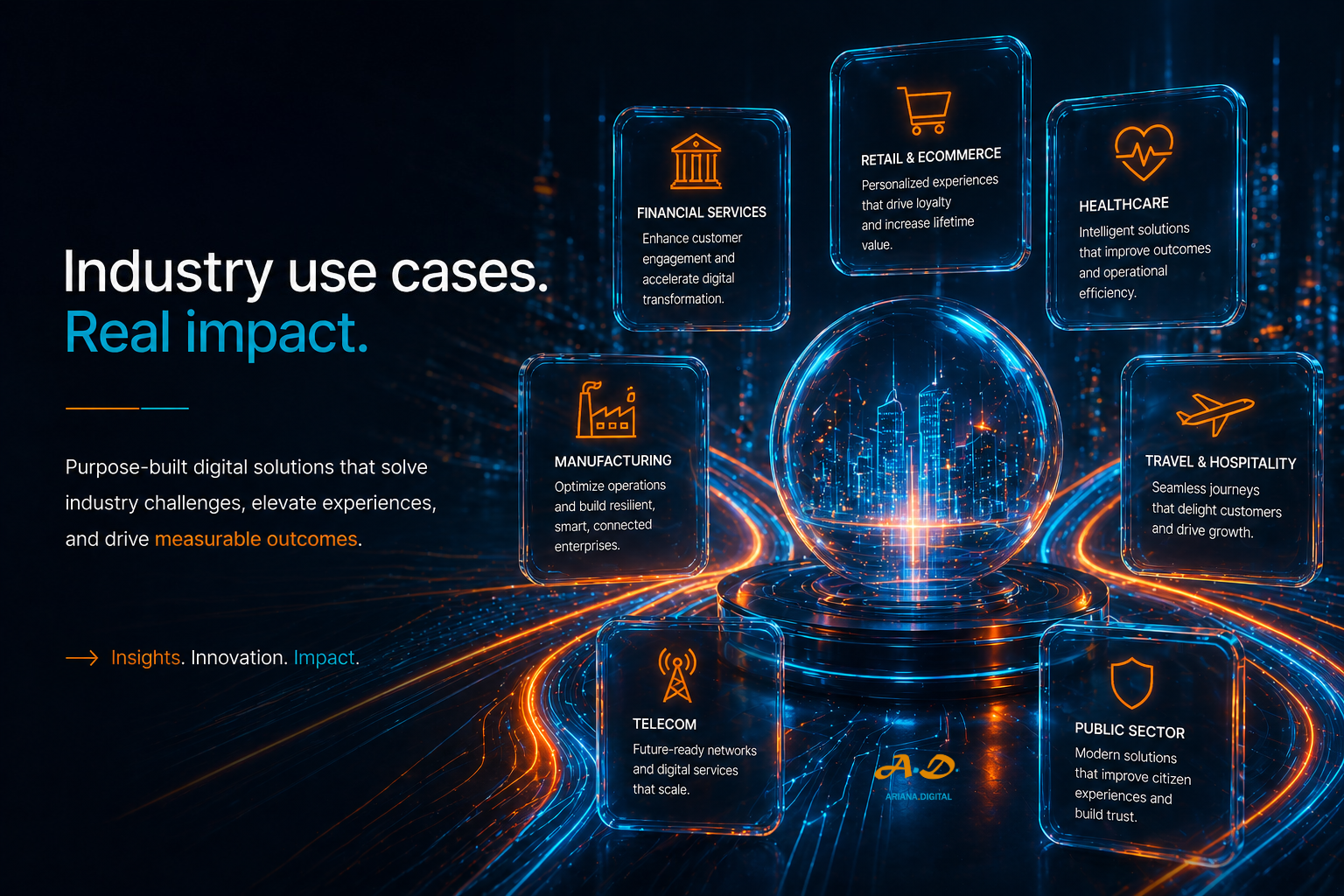
We focus on financial services, healthcare, manufacturing, and energy, with myndQ as the workforce layer across all four. The retail journey remains here as a supporting customer-experience pattern. These are illustrative journeys, not case files.
Agentic AI for regulated industries
The written architecture under these journeys. For each Financial Services, Healthcare, Manufacturing, and Energy subsector: which AEGIS pillars fire, what the regulator asks for, and a named model and platform stack.
A claim isn't data.
It's a person waiting.
Prior authorization queues, manual intake summaries, care-plan drafting, the slow tissue of healthcare operations is where patient experience and margin are both lost. What good looks like: an evidence-grounded intake agent that compresses 14-day turnarounds into hours, while making the compliance committee happier, not less so.
Agents pasted PDF claim data into five systems. Prior auth sat in a queue for 14 days on average. 9% of routine cases were escalated unnecessarily because the intake summary missed the context.
An evidence-grounded intake agent that reads the submission, pulls the policy, drafts a decision and a cited rationale. A human approves, never the other way around. Everything logs to audit from second zero.
A Run team monitors drift every shift. Policy changes propagate in hours, not quarters. The board gets a monthly score on cycle time, appeal rate, and member-experience NPS, three numbers, one page.
What we don't promise: a fixed number on day one. The Diagnostic ranks bets, the Build ships the first one, the Run team makes sure the numbers above actually show up on your floor.
See the Reference Architecture Studio → : 875 capabilities, 1,072 L1–L3 workflows, ecosystem platforms, and public case studies.
Underwrite faster.
Explain every time.
Lenders and commercial insurers face a paradox, customers want instant decisions, regulators want traceable ones, and by mid-2026 most firms have agents in production with real autonomy. What good looks like: a pre-screen agent and memo drafter that cuts cycle time by two-thirds while adding, not removing, the audit trail supervisors now ask for first.
Senior underwriters spent two days per file reading financials, cross-referencing covenants, and typing up memos. Committee meetings ran twice a week and 40% of cases were still waiting on one data pull. Meanwhile, 62% of financial services firms have deployed AI agents, and 93% of those grant agents autonomy over decisions, not just recommendations.
A retrieval-grounded agent reads statements, flags covenant issues, drafts the credit memo, and cites every number back to the source doc. Underwriters review and sign, or override with one line of reasoning that audit gets to keep.
Every decision is reconstructable, model version, retrieval window, prompt, human override, agent action log. Supervisory frameworks are converging: the FCA Mills Review and HM Treasury's AI Adoption Plan (Jul 2026) both ask for discloseable, contestable outcomes. A Run team files quarterly model-risk evidence packets the first-line doesn't have to build from scratch.
The constraint is rarely the model. It's how your model-risk policy is written, and how your first line documents overrides today. The Diagnostic decides whether to fix that first or build alongside it.
See the Reference Architecture Studio → : 875 capabilities, 1,072 L1–L3 workflows, ecosystem platforms, and public case studies.
Omnichannel is a
throughline, not a stack.
Every retailer with a 2018 digital strategy is now sitting on eight touchpoints that don't remember each other. Chat doesn't know the email. Email doesn't know the call. The customer does. What good looks like: a single, personalized thread across every door, with recognizable economics, retention, expansion, cost-to-serve.
A buyer starts in chat, gets escalated to email, calls two days later, and retells the story each time. NPS is fine. Retention is quietly bleeding. Marketing blames service. Service blames the CRM.
A chat-first personalization layer on top of Salesforce. Every interaction is summarized, scored, and threaded. Next-best-action is suggested to the rep, drafted in their tone, ready to send. Customer lifts are traceable to the specific touch.
Retention, expansion, cost-to-serve, all three reported monthly to the CEO from the same data layer. When a marketing promo changes, the assistant adapts tone and offer in hours, not sprints.
What "good" depends on: the cleanliness of your customer-data spine and the quality of the content engine sitting next to it. The Diagnostic tells you which gates have to open first.
The line knows.
The system should too.
Plants and grids are sensor-rich and signal-poor. Operators carry pattern memory in their heads, when a pump is "about to go," which feed runs dirty after a wet week, why Line 3 always limps on Mondays. What good looks like: that tacit knowledge captured as evals, surfaced to the next operator, and tied to yield, uptime, and energy cost the CFO actually sees.
OT data sits in PI, SCADA, MES, LIMS, none of them speaking to each other. Reliability engineers chase tickets after the fact. Energy procurement is decoupled from operations. The plant manager's gut is the most accurate forecasting tool in the building.
An agent that reads time-series, log books, and shift notes; flags anomalies in plain language; drafts the work order with the right part numbers and safety steps; and explains why. Operator approves, override is logged, the model learns. Nothing leaves the OT boundary you draw.
A Run team tunes anomaly thresholds by asset class and season. Monthly read-out to the COO and CSO: unplanned downtime avoided, first-pass yield, energy intensity per unit, three numbers that used to be three different meetings.
The hard part isn't the model. It's the OT-network discipline, the safety case, and the operator trust loop. The Diagnostic tells you whether you're ready, and what to fix first if you're not.
Hiring is broken.
Both sides know it.
Recruiters are drowning in AI-written résumés. Candidates are ghosted by AI screeners. Meanwhile, every enterprise needs Agentic AI engineers, cloud architects, XR developers, roles where a traditional pipeline doesn't exist. myndQ is how we fixed it, end-to-end.
Recruiters screen 400 applications for one hire, most of them AI-embellished. Candidates send 80 applications to get three callbacks. Nobody trusts anything. The hire takes 84 days, if it happens at all.
For candidates: AI-conducted interviews, personalized learning pathways into Agentic AI curricula co-built on frontier AI infrastructure. For employers: verified skill profiles with evidence, SOC 2-ready, bias-audited, with deployer duties for Colorado SB 26-189 (Jan 1, 2027) and NYC LL144 bias-audit requirements built in.
myndQ for Business plugs into your ATS for new hires. myndQ TalentHub is open to any job seeker. We partner on cohort programs for employers committing to reskilling, the most durable way to solve the talent gap nobody's talking about.
your stack already runs on
 Microsoft
Adobe
NVIDIAInception
OpenAI
Anthropic
Microsoft
Adobe
NVIDIAInception
OpenAI
Anthropic
Your industry
has a shape. Let's map it.
Three-week Diagnostic. Fixed fee. You walk out with a ranked shortlist and a board-ready brief, whether or not we continue.
platforms your stack
already runs on
Microsoft
Adobe
NVIDIAInception
OpenAI
Anthropic