AI Vendor Acquired or Bankrupt? What Happens to Your Chat Logs · Enterprise Agentic AI Insights
When an AI vendor is sold or fails, your prompts and chat logs can go with it. Check four exit terms, build the register and test a deletion.
1. What the CIO is staring at
Ask a CIO how many AI tools hold the company's prompts, uploaded files and generated outputs, and the honest answer is usually a range. A dozen sanctioned assistants and copilots. Another dozen niche tools that a team signed up for on a card. Whatever employees paste into a browser tab.
Now ask the next question: if one of those vendors is acquired next quarter, or runs out of cash, where do those conversations go? Who owns them the day after? Can we get them deleted, and can we prove it?
That second question rarely has an owner. Procurement signed the order form. Security reviewed the data flows at onboarding. Legal negotiated a data processing addendum, if there was one. Nobody was asked what happens when the counterparty itself changes hands.
This week made it concrete. A consumer AI company, Character.AI, has put its platform and the private chat histories of more than 21 million U.S. accounts up for auction on December 1, 2026, four days from today. More than 2.1 million of those accounts are registered to minors. The chats are linked to IP addresses, metadata and per-user risk scores. VERIFIED C01
It is a consumer service, not an enterprise one. The mechanics are the same.
2. The mechanic that is failing
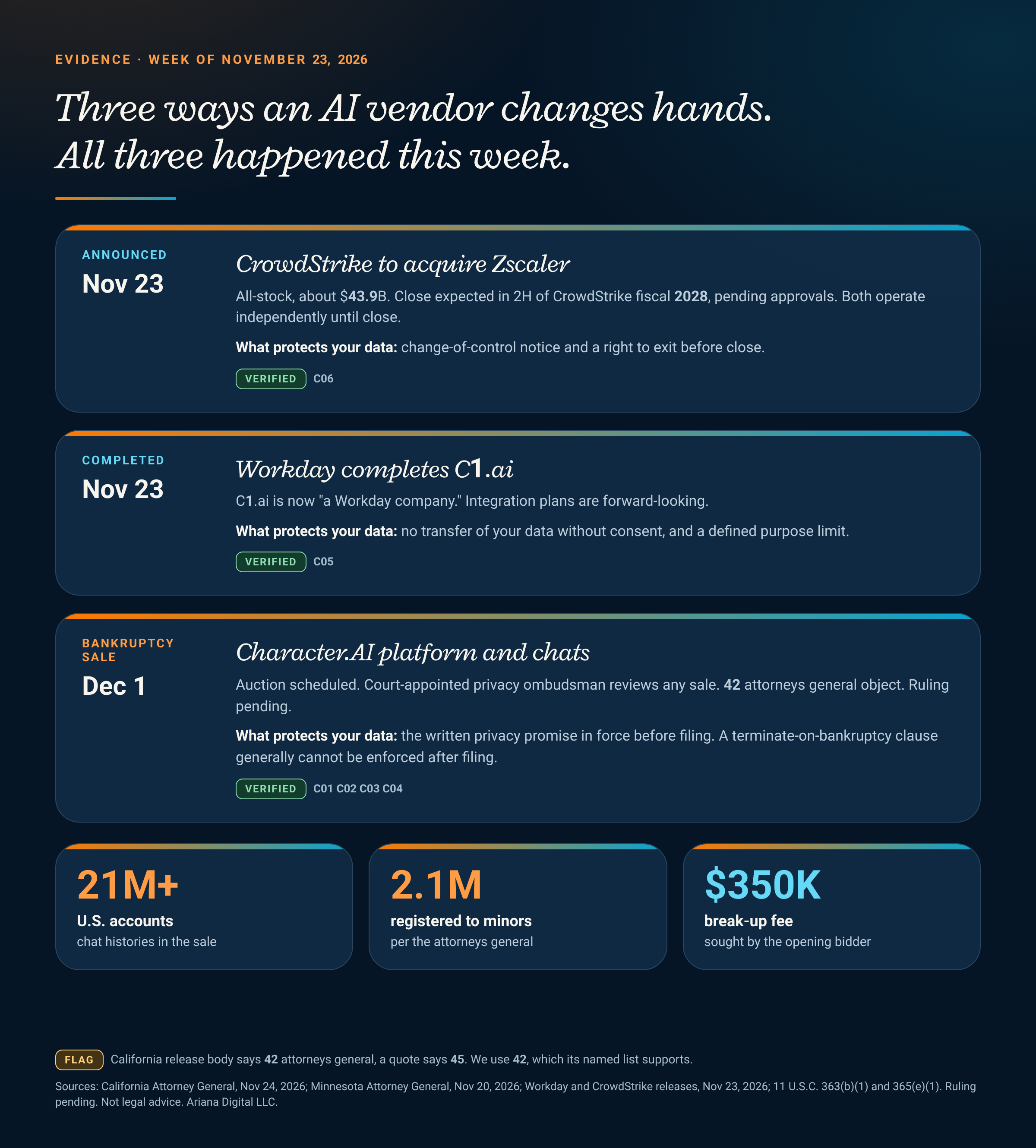
An AI vendor can change hands in three ways, and this week supplied a live example of each.
Acquisition announced. On November 23, CrowdStrike and Zscaler signed a definitive agreement for CrowdStrike to acquire Zscaler in an all-stock deal valued at about $43.9 billion. Close is expected in the second half of CrowdStrike's fiscal 2028, subject to Zscaler shareholder and regulatory approval. Until then, the companies say, both operate independently. VERIFIED C06 For a customer, nothing has moved yet. Everything you agreed to is about to be renegotiated by someone else's integration plan.
Acquisition completed. The same day, Workday completed its acquisition of C1.ai, an identity platform that connects people and AI agents to enterprise systems "with scoped access, enforced policies, human approval, and a record of every action." C1.ai now describes itself as "a Workday company." VERIFIED C05 For a customer, the counterparty is new, and so is the parent that may want to combine its data with Workday's employee records. Workday's own release says the integrated capabilities are forward-looking and "may not be delivered as planned or at all."
Sale out of bankruptcy. Character.AI is selling nearly everything it owns at auction. The only disclosed bidder so far was formed as a Delaware company on November 13 and picked as the opening bid one day later. The proposed sale terms, as described by the states objecting to them, would not require the buyer to follow Character.AI's privacy policy, honor deletion or opt-out requests, or refrain from selling the data on. VERIFIED C01
Three different paths, one shared gap. In each case the data a customer put into the system becomes an asset on someone else's balance sheet, and the customer's position depends entirely on what was written down before the event.
Here is where enterprise contracts usually go quiet:
- Retention. How long does the vendor keep prompts, outputs, embeddings, logs and fine-tune data? Many order forms point to a policy page the vendor can change.
- Change of control. Does the vendor have to tell you before an acquisition closes? Can you terminate and get your data back first?
- Insolvency. Does anything survive if the vendor files? (Section 3 explains why a "terminate on bankruptcy" clause is weaker than most people assume.)
- Proof. Can the vendor certify deletion, including backups and any derived model artifacts, within a time you choose?
The tools staff adopted without procurement have none of this. Their terms are whatever the click-through said on the day someone accepted it.
3. The governance turn
The Character.AI case shows how a court and regulators actually treat conversation data when a vendor fails. Four points carry straight across to enterprise buyers.
The privacy promise is what gets tested. U.S. bankruptcy law says that if a debtor told individuals it would not transfer their personally identifiable information, and that policy was in effect when the case began, the trustee may not sell that information unless the sale is consistent with the policy, or a consumer privacy ombudsman is appointed and the court approves the sale after notice and a hearing. VERIFIED C03 Character.AI's privacy policy said "we do not sell personal information for monetary consideration." VERIFIED C01
An ombudsman is now in the case. On November 20 the Minnesota Attorney General announced that, at the urging of a 40-state coalition, the court ordered a Consumer Privacy Ombudsman to review any proposed sale involving user accounts, chat data or AI-related assets. The U.S. Trustee selected data privacy expert Lucy Thompson. She will file reports before any assets can be sold. VERIFIED C02
Forty-two attorneys general are objecting. On November 24 a bipartisan coalition of 42 attorneys general asked the court to deny the proposed sale terms, reject the opening bidder and its proposed $350,000 break-up fee, and at minimum carve out children's chats and other sensitive data. Their argument is that bankruptcy does not suspend federal children's privacy law or state privacy law. VERIFIED C01 The California release gives 42 in its body and 45 in a quote; we use 42, the number its named list supports. FLAG C01
Your exit clause may not fire. Many enterprise contracts let the customer terminate if the vendor becomes insolvent. Once a bankruptcy case starts, the Bankruptcy Code says an executory contract "may not be terminated or modified" solely because of a provision conditioned on the commencement of the case. VERIFIED C04 The protection you thought you had needs to sit somewhere else: in notice and deletion duties that trigger earlier, and in data you never let the vendor keep.
There is also a calendar. The same coalition notes that California, Colorado, New York and Connecticut have chatbot safety laws taking effect on January 1, 2027, 35 days from today. CITED C07 We have not read those statutes for this report; treat the date as the attorneys general's statement.
Nothing here is decided. The objection is filed, the auction is scheduled and the court has not ruled. The direction is clear regardless of the outcome: the record of what a vendor promised, and what a customer can prove about where its data went, is what regulators and courts look at.
That makes it a board question, not a procurement one. In the Ariana AEGIS Model (Agentic Enterprise Governance and Intelligence Standard) it lands in four places:
- Pillar 2, AI System Inventory. You cannot protect conversation data held by vendors you have not listed, with data classes you have not recorded.
- Pillar 3, Risk and Impact Assessment. Vendor failure and change of control belong in the risk assessment for each AI system, beside accuracy and security.
- Pillar 5, Transparency and Rights. If you made promises to employees or customers about how their data is handled, those promises have to survive your vendor's sale.
- Pillar 1, Governance Architecture. Someone has to own AI contract terms across procurement, security and legal, with authority to stop renewals that lack them.
Framework reference: https://ariana.digital/ai-governance.html PROPRIETARY C09
4. The move
This is a two-week piece of work, not a program. Do it in this order.
1. Build the register from logs, not surveys. Pull the OAuth grants and SSO app list from your identity provider, filter for AI tools, and add the card-paid tools from expense data. For each vendor record: data classes sent (internal, customer, regulated), retention period, where it is stored, and whether a signed agreement exists. The interactive linked below gives the starter commands.
2. Sort vendors into three bins. Covered (contract names retention, change-of-control notice, deletion on exit and a certificate). Contract-silent (signed, but quiet on one or more). Uncontracted (click-through only). Put anything holding regulated or customer data at the top of each bin.
3. Send one amendment letter to the silent bin before year end. Four clauses: written notice before any change of control closes; your right to terminate and retrieve data before it closes; deletion of prompts, outputs, logs and derived artifacts on exit, including backups, with a certificate within a stated period; and no transfer of your data to a successor without your written consent. Your counsel will word them for your jurisdiction.
4. Move the uncontracted bin. Either bring the tool under contract or block it and give people a sanctioned alternative. A tool with regulated data and no contract is the item to take to the next risk committee.
5. Test one deletion. Pick your highest-volume AI vendor. Request deletion of a defined test dataset and time the certificate. The answer tells you more than the contract does.
6. Watch the calendar. December 1 is the auction. Whatever the court decides, read the ombudsman's report when it is filed; it will be the clearest public statement yet of what protections a court expects around AI conversation data.
5. What this does not establish
- The Character.AI case concerns a consumer service and individuals' data. Enterprise customers' rights in a vendor bankruptcy turn mainly on their contracts, not on the consumer privacy rule quoted above.
- We have not read the coalition's filing PDF, the court's order appointing the ombudsman, or the four state chatbot statutes. Facts about them come from the California and Minnesota attorneys general.
- Nothing in this report suggests CrowdStrike, Zscaler, Workday or C1.ai will mishandle customer data. They are examples of ordinary change of control, chosen because they happened this week.
- This is not legal advice. Ariana Digital is not a law firm. Confirm clause wording with counsel.
Get the check
<div data-ariana-embed="ai-vendor-exit-check"><p><a href="/assets/tools/ai-vendor-exit-check.html" target="_blank" rel="noopener">Open the AI Vendor Exit Check →</a></p></div>
The AI Vendor Exit Check runs on your own numbers: how many AI tools hold your data, how many are under contract, and how many say what happens on a sale. It returns a tiered verdict with a distinct next move and gives you the register schema, the four clauses and the commands. The full runbook PDF is behind a short form.
Principal led, domain-savvy AI-ready teams. Book a discussion: https://ariana.digital/services.html
Sources
C01California Attorney General, "Attorney General Bonta Opposes Asset Sale of Character.AI Amid Child Safety Concerns," November 24, 2026. https://oag.ca.gov/news/press-releases/attorney-general-bonta-opposes-asset-sale-characterai-amid-child-safety-concernsC02Minnesota Attorney General, "Attorney General Ellison protects kids' privacy in Character.AI bankruptcy," November 20, 2026. https://www.ag.state.mn.us/Office/Communications/2026/11/20_CharacterAI.aspC0311 U.S. Code § 363(b)(1), Legal Information Institute, read November 27, 2026. https://www.law.cornell.edu/uscode/text/11/363C0411 U.S. Code § 365(e)(1), Legal Information Institute, read November 27, 2026. https://www.law.cornell.edu/uscode/text/11/365C05Workday, "Workday Completes Acquisition of C1.ai," November 23, 2026. https://newsroom.workday.com/2026-11-23-Workday-Completes-Acquisition-of-C1-aiC06CrowdStrike, "CrowdStrike to Acquire Zscaler, Bringing Network Security and Zero Trust to the Falcon Platform," November 23, 2026. https://www.crowdstrike.com/en-us/press-releases/crowdstrike-to-acquire-zscaler-bringing-network-security-and-zero-trust-to-the-falcon-platform/C07State chatbot safety laws effective January 1, 2027, as stated in the California Attorney General release of November 24, 2026 (statutes not opened). Same URL as C01.C08TechCrunch, "Character.AI's plan to auction off users' private chats challenged by state AGs," November 25, 2026 (corroboration only). https://techcrunch.com/2026/11/25/state-ags-fight-character-ais-plan-to-auction-off-users-private-chats/C09Ariana AEGIS Model, seven pillars. https://ariana.digital/ai-governance.html
© Ariana Digital LLC. All rights reserved.